An AI rack runs two networks. The scale-up fabric joins all 72 GPUs through NVLink Switch trays at 130 TB/s, and the scale-out network gives each GPU an 800 Gb/s SuperNIC link to top-of-rack and leaf switches that tie racks into a cluster (NVIDIA GB300 NVL72). DPUs, PCIe retimers and PCIe switches handle storage, security and the lanes inside each tray.
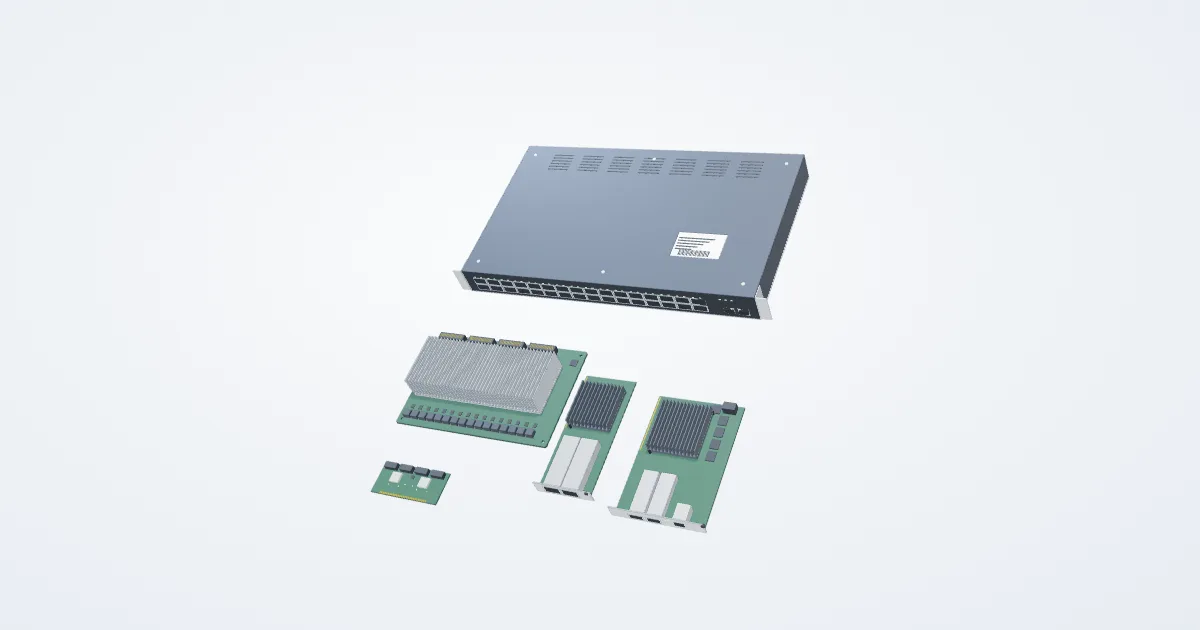
A scale-up switch tray with two switch chips, plus the network cards, DPU, retimers and the top-of-rack switch that connect the rack to the rest of the cluster.
Switch chips join every GPU in the rack into one domain. Network cards and DPUs carry traffic to other racks, retimers keep fast signals clean, and the top-of-rack switch links the trays’ management ports, and in some designs their data ports, to the wider network.
Illustrative switch tray and network cards example. Designs differ by manufacturer; the model is not a bill of materials.
What to look for: The two switch chips on the switch tray’s board, the network and DPU cards with their cages, the small retimer chips near the connectors, and the switch box with rows of ports.
Scale-up joins the GPUs inside one rack into a single fast domain; in NVL72 that is NVLink, through switch trays and a copper spine. Scale-out links racks to each other over Ethernet or InfiniBand, through NICs and top-of-rack or leaf switches. They use different chips and often different vendors: NVIDIA controls NVLink, while Ethernet scale-out is open to Broadcom, Cisco, Arista and white-box builders such as Celestica and Accton.
Does a partner list or ecosystem badge prove a company is inside NVL72?
No. NVIDIA’s lists of Blackwell or MGX partners, and an NVIDIA quote in a supplier’s release, show collaboration on a platform. They do not show that a part ships in a given rack, in what volume or at what share. Each row says whether its role rests on the company’s own disclosure, a partner’s document or its product positioning.
NVIDIA designs the NVLink Switch chips, ConnectX SuperNICs, BlueField DPUs and Spectrum-X switches for its racks. Broadcom and Cisco design Ethernet switch silicon, and Arista, Cisco, Celestica and Accton sell the Ethernet switches that link racks. Astera Labs, Marvell, Credo and Microchip make PCIe retimers and switches.
Open each company below for its source and limitations. Sector membership does not establish a confirmed supply contract.
Inside the assembly
Switch ASICs
Scale-up switch chips that connect every GPU in the rack to every other GPU at full bandwidth. Other designs use Ethernet switch chips for the same job.
Stock-link scope: Scale-up and fabric switch chips. NVIDIA’s NVLink Switch chips sit in the 1RU switch trays of GB200/GB300 NVL72 (NVIDIA OCP contribution, Oct 15, 2024), and its Spectrum-6 Ethernet ASIC runs 102.4 Tb/s. Broadcom sells Ethernet switching silicon to hyperscalers and to makers of AI servers, switches and racks (FY2025 10-K); Cisco’s Silicon One G300 (102.4 Tb/s) powers its own systems; Astera Labs’ Scorpio X-Series is a scale-up fabric switch for up to 80 accelerators; Marvell’s 10-K lists Teralynx Ethernet switches of up to 51.2 Tb/s. Celestica designs AMD Helios’s scale-up switch trays on other companies’ silicon and is listed under the top-of-rack switch, not here.
Network cards at 400 to 800 Gb/s, about one per GPU, that carry scale-out traffic over InfiniBand or Ethernet to other racks.
Stock-link scope: GB300 NVL72 gives each GPU 800 Gb/s through ConnectX-8 SuperNICs (NVIDIA product page); ConnectX-9 offers 1.6 Tb/s. Broadcom sells Ethernet NICs into AI data centers (FY2025 10-K), and AMD’s Pensando Pollara AI NICs are the alternative in AMD systems such as Helios. Some hyperscalers use in-house NICs (analyst reports), which are not listed products.
Data processing units: network cards with their own processor cores that offload storage, security and virtualization from the host CPU.
Stock-link scope: NVIDIA’s BlueField-3 (400 Gb/s) and BlueField-4 (800 Gb/s) DPUs offload networking, storage and security; NVIDIA lists two BlueField-3 DPUs per GB200 compute tray. AMD’s Pensando DPUs are the alternative in AMD designs. Intel IPUs and Marvell OCTEON DPUs had no AI-rack evidence in our sources and are not mapped.
Chips that recover and re-send high-speed PCIe or CXL signals over long board traces and cables, or fan one set of lanes out to many devices.
Stock-link scope: Astera Labs sells Aries retimers and Scorpio P-Series PCIe 6 switches, which an NVIDIA executive says integrate with Blackwell-based MGX (Mar 18, 2025). Marvell’s Alaska P PCIe 6 retimers were adopted by Supermicro, TE Connectivity and TeraHop (Dec 9, 2025). Credo’s Toucan Gen6 x16 retimer was PCI-SIG listed on Aug 31, 2026; Broadcom’s PCIe interconnect chips serve AI and non-AI uses (10-K); Microchip’s Switchtec Gen 6 switches are sampling; Montage calls itself one of the two major PCIe 5.0 retimer suppliers and says retimers are core components of AI servers (2025 results). No source says which retimer or switch a given NVL72 tray uses.
The rack’s own switch boxes. In the reference design they carry the management network for every tray, while scale-out traffic leaves through each tray’s network cards; other designs also aggregate data traffic here.
Stock-link scope: The rack’s own switches. In NVIDIA’s reference rack the in-rack switches carry the management network, and scale-out traffic leaves through each tray’s SuperNICs to leaf switches. NVIDIA’s Spectrum-X Ethernet switches (SN5000/SN6000) are its reference fabric, and Meta and Oracle said they would adopt them (Oct 13, 2025). Arista (7060 AI leaf, 7800R AI spine), Cisco (Nexus N9000/N9100 and G300 systems), Celestica (hyperscale 800G white-box switches) and Accton’s Edgecore (51.2 Tb/s AIS800-64D) sell Ethernet switches for AI clusters, and Foxconn Industrial Internet reports that its 800G-and-above switch shipments rose more than 13-fold in 2025. The operator decides which switch serves a rack.
Disclosed: AMD’s Advancing AI 2026 release describes Helios with 72 MI455X GPUs, 18 Venice CPUs and Pensando networking, and names its adopters and system partners.
Disclosed: Astera Labs’ 2025 10-K describes its products and customer concentration; its Mar 18, 2025 release carries an NVIDIA executive’s statement on Scorpio P-Series in MGX.
Disclosed: Celestica’s Q3 2025 results exhibit and the Celestica–AMD release describe its switch programs, the rack-scale AI award and the Helios scale-up switches.
Disclosed: Cisco’s fiscal 2026 results give the hyperscaler AI orders and revenue; its newsroom describes Silicon One G300, the N9100 and UCS AI servers.
Partner-disclosed: AMD’s release says HPE will be one of the first OEMs to offer its Helios rack-scale platform; NVIDIA names HPE among Blackwell Ultra server makers. HPE’s own GB200 NVL72 release was seen in search results only.
Disclosed: Marvell’s FY2026 10-K describes its custom AI silicon, electro-optics DSPs, AEC DSPs for AI scale-up and scale-out, PCIe retimers and Teralynx switches.
Disclosed: NVIDIA’s GB300 NVL72 and DGX GB300 pages give the GPU, CPU, NVLink, ConnectX-8, BlueField-3 and NVLink Switch counts, and its FY2026 10-K names its foundry, memory and assembly partners.
Evidence groupings are not investment ratings. Companies may appear in multiple sectors.
AI Networking Stocks: Switches, NICs & Retimers | stock3d