| Link | Where it runs | A documented figure | Examples of connected companies |
|---|---|---|---|
| Copper cable spine | Compute trays to NVLink switch trays inside the rack | Over 5,000 cables in four cartridges (NVIDIA) | Luxshare, Amphenol, TE Connectivity |
| Active electrical cable | Network cards to switches, and switch to switch, over a few meters | Up to 7 m and up to 50% less power than active optical cables (Credo) | Credo, Marvell, Astera Labs, BizLink, Microchip |
| Linear active copper cable | Short links to 200G-per-lane switches and accelerators | Under 2 W per cable end (Semtech) | Semtech, Amphenol |
| Pluggable optical transceiver | Scale-out links that leave the rack | 800 Gb/s per GPU in GB300 NVL72 (NVIDIA) | Innolight, Eoptolink, Coherent, Lumentum, Fabrinet |
| Co-packaged optics | Optical engines beside the switch chip, with separate laser modules | 4x fewer lasers and 3.5x more power efficiency (NVIDIA’s claim, Mar 2025) | NVIDIA, TSMC, Lumentum, Coherent, TFC |
| Fiber and connectivity | From the rack to the network | Up to 1,152 fibers per NVL72 rack (AFL) | Corning, Fujikura, Furukawa Electric, Sumitomo Electric |
Two networks, two media
An NVL72-class rack runs a scale-up network that joins its 72 GPUs into one NVLink domain and a scale-out network that links racks into a cluster. In GB300 NVL72 the scale-up fabric carries 130 TB/s through nine switch trays, while each GPU gets 800 Gb/s of scale-out bandwidth through ConnectX-8 SuperNICs.
The two use different media for a physical reason. At 200 Gb/s per lane, IEEE’s objective for copper twinax is a reach of at least 1 m, while single-mode fiber reaches 500 m to 2 km. Links that stay inside one rack can be copper; links that leave it are usually optical.
Reference: IEEE P802.3dj: adopted objectives.
Copper inside the rack
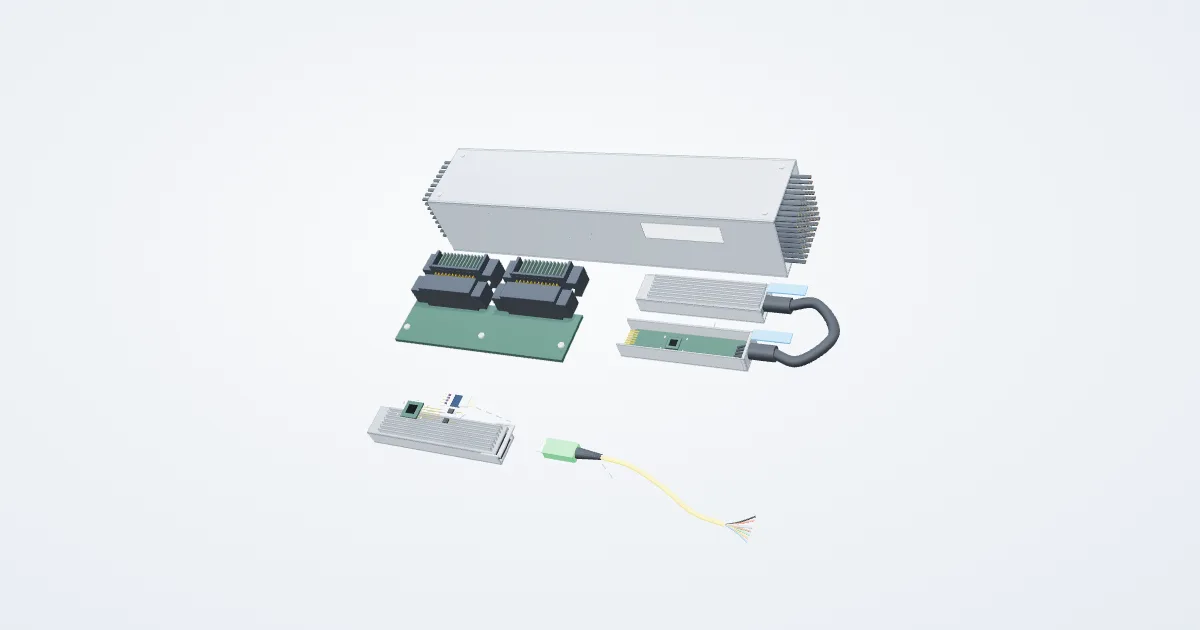
NVIDIA joins the compute and switch trays through four vertical cartridges at the rear that hold over 5,000 copper cables, with no optics in between. Copper needs no lasers or module power, and the trays dock blind into backplane connectors as they slide in.
NVIDIA names no cartridge supplier. Luxshare says its cable cartridge is in commercial use in certain mainstream AI clusters, TE Connectivity markets cabled-backplane connectors with its own 224G cable, and SemiAnalysis’s attribution of the NVLink backplane to Amphenol is analyst context, not a disclosure by either company.
Reference: NVIDIA: GB200 NVL72 designs contributed to OCP (Oct 15, 2024).
Active copper stretches the reach
Where a link runs a few meters, between network cards and switches or between switches, active electrical cables add retimer or DSP chips in the plugs. Credo’s ZeroFlap cables run up to 7 m and use up to 50% less power than active optical cables, and Credo’s fiscal 2026 revenue rose to $1.3 billion from $436.8 million a year earlier.
A lower-power variant, the linear active copper cable, uses redrivers instead of retimers: Semtech’s CopperEdge chips sit in Amphenol’s 1.6T OSFP cable at under 2 W per cable end. Marvell, Astera Labs, Microchip, BizLink and Luxshare also sell AEC chips or cables; no source ties a specific cable to NVL72.
Reference: Credo: ZeroFlap active electrical cables.
Optics outside the rack
Scale-out traffic leaves through pluggable transceivers: OSFP modules carry 800G on eight 100G lanes or 1.6T on eight 200G lanes, each with lasers, a DSP, drivers and TIAs. NVIDIA names Coherent, Eoptolink, Fabrinet and Innolight as pluggable-transceiver leaders, and in March 2026 it invested $2 billion each in Coherent and Lumentum with multibillion-dollar purchase commitments for lasers and optical products.
The fiber plant grows with the optics. Fujikura’s AFL says a leading-edge NVL72 rack can be fed with up to 1,152 fibers; Lightera, Furukawa Electric’s fiber business, mass-produces a 13,824-count cable; and Corning will raise its US optical-connectivity capacity tenfold under a May 2026 partnership with NVIDIA.
Reference: NVIDIA: Spectrum-X Photonics co-packaged optics switches (Mar 18, 2025).
Will optics move inside the rack?
Co-packaged optics put the optical engines beside the switch chip and move the lasers into separate pluggable modules. NVIDIA’s March 2025 release claims 4x fewer lasers and 3.5x more power efficiency for its Quantum-X and Spectrum-X Photonics switches, and names TSMC, Lumentum, Coherent, Corning, Fabrinet, Sumitomo Electric, TFC and Browave in its ecosystem, with the private SENKO and ASE’s subsidiary SPIL.
Suppliers describe an early shift. Lumentum said in its Q4 FY2026 results that demand for co-packaged-optics lasers, a first laser-module order and near-packaged-optics engagements are the first signs of optics reaching in-rack connectivity, and Coherent’s CEO says AI data centers are moving from copper to optical connectivity. These are company views; timing and volumes are not established, and the illustrated rack keeps copper inside.
Reference: Lumentum: Q4 FY2026 results (8-K exhibit 99.1).
What it means for company research
Copper and optics are made by different companies. A cable-assembly or connector maker, a signal-chip designer, a module maker, a laser maker and a fiber maker each connect to a different part, and a change in the rack’s architecture can move content from one group to another.
Check each claim against a named system and generation. The copper spine described here is NVIDIA’s GB200 and GB300 design; a later rack may change it, and a company’s role in one generation needs new evidence in the next. Open the interconnect parts in the interactive 3D model to see the evidence behind each connection.