How this system works
The rack’s wiring: a copper cable cartridge from the rear spine with its blind-mate connectors, an active electrical cable, and an optical transceiver opened to show its laser, DSP and fiber connection.
Inside the rack, copper cables and blind-mate connectors carry signals between trays. Active cables stretch copper a little further, and optical transceivers, driven by lasers and DSPs, send signals out of the rack over fiber.
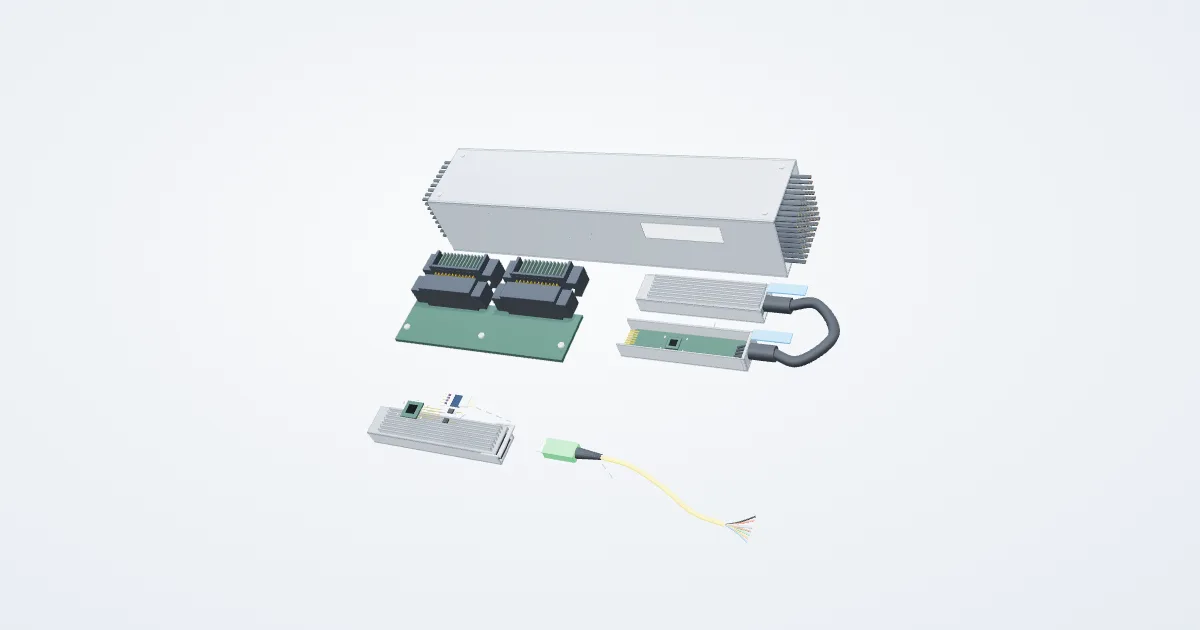
What to look for: The bundle of copper cables in its cartridge and the connector that docks it, the chip inside the active cable’s plug, and the laser, DSP and fiber port inside the opened transceiver.
Compare the right roles
Why is the rack copper inside and optical outside?
Distance and power. The 72 GPUs and nine NVLink switch trays sit in one rack, so NVIDIA joins them with a copper cable cartridge that needs no lasers or module power. Links to the rest of the cluster run far beyond copper’s reach, so each GPU’s 800 Gb/s scale-out connection in GB300 NVL72 goes through an optical transceiver and fiber. Active electrical cables stretch copper further with retimer or DSP chips in the plugs. Lumentum says optics are starting to reach in-rack links as speeds rise, but the illustrated rack keeps copper inside.
Will co-packaged optics replace pluggable transceivers?
Not in the illustrated rack. Co-packaged optics (CPO) put the optical engines beside the switch chip and move the lasers into separate pluggable laser modules. NVIDIA says its Quantum-X Photonics InfiniBand switch is available and Spectrum-X Photonics Ethernet switches are due in the second half of 2026, claiming 3.5x better power efficiency than pluggable transceivers and no DSP retimers. Its announced photonics products are switches, and its ecosystem includes TSMC for the silicon photonics, Lumentum, Coherent, Corning, Fabrinet, Sumitomo Electric, TFC, Browave and the private SENKO. Adoption timing and volumes are not established by these sources.
NVIDIA names Innolight, Eoptolink, Coherent and Fabrinet as pluggable-transceiver leaders, and in March 2026 it invested $2 billion each in Coherent and Lumentum alongside multibillion-dollar purchase commitments for lasers. Mitsubishi Electric, Sumitomo Electric and Broadcom also make datacom lasers, Marvell and Credo make PAM4 DSPs, and Corning, Fujikura and Furukawa make high-density fiber. On the copper side, Amphenol, TE Connectivity, Luxshare and BizLink make cable and connector systems and Credo sells active electrical cables; SENKO, in NVIDIA’s CPO ecosystem, is private.
Open each company below for its source and limitations. Sector membership does not establish a confirmed supply contract.
Inside the assembly
Copper cable spine
More than 5,000 copper cables, grouped in cartridges at the rear of the rack, link every compute tray to every switch tray without converting signals to light.
Stock-link scope: In GB200/GB300 NVL72, four NVLink cartridges at the rear hold over 5,000 copper cables joining the 1RU compute and switch trays (NVIDIA OCP contribution, Oct 15, 2024; NVIDIA calls them ‘active copper cables’, while most descriptions treat them as passive twinax). NVIDIA names no cartridge supplier. Luxshare says its Intrepid Cable Cartridge cable-backplane is in commercial use in certain mainstream AI clusters. SemiAnalysis (Jul 2024) reports Amphenol’s Paladin backplane as the initial primary source, an analyst attribution neither company confirms. TE markets Slingshot 224G cabled-backplane connectors with its own 224G cable for AI. Later NVIDIA designs may change the spine; that is not verified here.
High-speed connectors
Blind-mate connectors where each tray docks into the cable spine. Hundreds of tiny contacts must align within fractions of a millimetre as the tray slides in.
Stock-link scope: Blind-mate backplane and near-chip connectors: Amphenol’s Paladin HD 224G backplane interconnect (the NVL72 attribution is SemiAnalysis’s, not the company’s), TE’s AdrenaLINE Catapult near-chip and Slingshot 224G backplane connectors for AI/ML, and Luxshare’s 224G Intrepid NEXUS backplane connector and KOOLIO CPC/NPC, which it says are in commercial AI-cluster use. NVIDIA lists Molex (private, a Koch subsidiary) and LOTES among Blackwell partners without stating their parts; LOTES is not mapped.
Also in this part (not publicly listed): Molex Subsidiary of Koch Industries (private)
Active electrical cables
Copper cables with a retimer or DSP chip in each plug that cleans up the signal, extending copper’s reach to several metres at a fraction of the power of optics.
Stock-link scope: Copper cables with signal chips in the plugs, mostly for NIC-to-switch and switch-to-switch links. Credo sells complete ZeroFlap AECs to hyperscalers; Marvell’s Alaska A 1.6T AEC DSP names Amphenol, Molex and TE as cable partners (Jun 27, 2024); Astera Labs sells Aries and Taurus smart cable modules for AECs; BizLink and Luxshare sell retimed active copper cables (Luxshare showed a 1.6T OSFP AEC at OCP 2025); Microchip sells the META-DX2C 800G AEC retimer. Semtech’s CopperEdge redrivers power linear active copper cables (ACCs), such as Amphenol’s 1.6T OSFP ACC, a lower-power alternative to retimed AECs. No source ties a specific cable to NVL72. Montage launched PCIe 6.x and CXL 3.x AEC solutions in January 2026.
Also in this part (not publicly listed): Molex Subsidiary of Koch Industries (private)
Optical transceivers
Pluggable 800G and 1.6T modules that convert electrical signals to light and back for links that leave the rack.
Stock-link scope: 800G and 1.6T pluggable modules (OSFP) for the rack’s scale-out links. NVIDIA names Coherent, Eoptolink, Fabrinet and Innolight as pluggable-transceiver leaders (Mar 18, 2025). Innolight, Eoptolink and Accelink list 1.6T OSFP modules in their 2025 annual reports, Coherent and Lumentum describe 800G/1.6T modules in their 10-Ks, and AOI has a first 1.6T volume order of over $200 million from an unnamed hyperscaler. Fabrinet is a contract manufacturer (NVIDIA was 16.3% of FY2026 revenue), not a module brand. NVIDIA sells LinkX-branded optical transceivers without naming their makers. TFC supplies optical engines and passive parts that go inside modules, and Credo sells ZeroFlap optical transceivers. None of these sources gives volumes or says which system a given module ships into. Cisco ships 1.6T OSFP and 800G linear-drive optics with its Silicon One systems, and Luxshare lists 800G and 1.6T optical modules in small-batch supply.
Lasers & photonics
Electro-absorption modulated or continuous-wave lasers, and silicon-photonics chips, that turn the signal into light inside the transceiver.
Stock-link scope: InP lasers (EML, CW, VCSEL) and silicon-photonics chips inside modules and co-packaged engines. Lumentum and Coherent make EMLs and CW/high-power lasers and hold NVIDIA purchase commitments for lasers (Mar 2, 2026); Mitsubishi Electric estimates it led data-center EML chips in FY25 and plans over 3x EML capacity by FY30; Sumitomo Electric makes EMLs and CW lasers for AI data centers; Broadcom runs in-house InP/GaAs laser fabs and sells a pluggable laser source for its CPO switches. TSMC provides the silicon photonics in NVIDIA’s CPO switches, Tower runs silicon-photonics foundry platforms for 400G–1.6T modules, TFC makes external-laser-source modules, Furukawa sells CW-DFB chips for silicon photonics, Marvell includes silicon photonics in its interconnect portfolio and MACOM sells lasers and photodetectors. AXT supplies InP substrates upstream. AOI makes laser chips only for its own modules and is mapped under transceivers. TrendForce (reported, context only) puts combined EML and CW-DFB capacity near 50.7 million units a month in 2026.
Optical DSPs & drivers
PAM4 digital signal processors, laser drivers and amplifiers that encode, equalize and retime the signal at each end of an optical link.
Stock-link scope: PAM4 DSPs retime and equalize each lane; drivers and TIAs amplify the electrical signal on each side of the laser and photodiode. Marvell (PAM DSPs, laser drivers, TIAs and LPO chipsets for AI data centers, FY2026 10-K), Credo (Bluebird, a 3 nm 200G-per-lane DSP for 1.6T modules, plus 100G-per-lane families, FY2026 10-K) and MACOM (TIAs and modulator drivers for 800G–3.2T modules, FY2025 10-K) are mapped, and Semtech’s TIA and modulator driver were demonstrated in NVIDIA’s 1.6T DR8 OSFP transceiver at OFC 2026. Broadcom’s optical DSP line could not be read from a primary source in our review, so Broadcom is mapped under lasers only. Linear-drive (LPO/LRO) modules drop some DSP functions, and NVIDIA says its co-packaged switches need no DSP retimers.
Fiber & cabling
High-density optical fiber cables and multi-fiber connectors that carry the light from the rack to the cluster’s switches.
Stock-link scope: Fiber cable, MPO/MMC connectivity and patching from the rack to the network. Corning will raise US optical-connectivity capacity 10x under its May 2026 NVIDIA partnership; Fujikura’s AFL says an NVL72 rack can be fed with up to 1,152 fibers and sells ultra-high-fiber-count cable; Furukawa’s Lightera mass-produces a 13,824-count cable for AI hyperscale data centers; Sumitomo Electric markets a 6,912-fiber cable and high-density connectors; Browave, a Taiwanese passive-optics maker, is in NVIDIA’s CPO ecosystem. SENKO, also named by NVIDIA, is private. The SDM4 multicore-fiber MSA (AFL, Corning, Sumitomo Electric, TeraHop) is a specification, not a product. Other listed cable and connector makers were not verified for AI fiber in our September 2026 review. Amphenol added fiber connectivity with the CommScope connectivity and cable business it bought (closed Jan 9, 2026), and BizLink sells fiber cassettes.
Also in this part (not publicly listed): SENKO Advanced Components Not publicly listed, AFL (America Fujikura Ltd.) Subsidiary of 5803.T, Lightera Subsidiary of 5801.T