| System | What it does | A documented figure | Examples of connected companies |
|---|---|---|---|
| GPUs, HBM & packaging | Two-die GPU packages with HBM stacks on an interposer and an ABF substrate | 72 GPUs and 20 TB of HBM3E in GB300 NVL72 (NVIDIA) | NVIDIA, AMD, TSMC, SK hynix, Micron, Samsung Electronics, Ibiden |
| CPUs, memory & storage | Host CPUs, LPDDR5X memory, E1.S drives and a management controller in each tray | 36 Grace CPUs with 2,592 Arm cores per GB300 NVL72 rack (NVIDIA) | NVIDIA, Arm, Micron, Sandisk, ASPEED |
| Switches & network chips | NVLink switch chips for scale-up; SuperNICs, DPUs and rack switches for scale-out | Nine switch trays and 130 TB/s of NVLink bandwidth (NVIDIA) | NVIDIA, Broadcom, Astera Labs, Arista, Cisco |
| Cables, optics & connectors | A copper cable spine inside the rack; optical transceivers and fiber outside it | Over 5,000 copper cables in four cartridges (NVIDIA) | Luxshare, Amphenol, TE Connectivity, Innolight, Coherent, Corning |
| Power shelves & delivery | AC-to-DC shelves, a DC busbar and voltage regulators down to the chips | Eight shelves of six 5.5 kW supplies, about 120 kW per rack (NVIDIA DGX guide) | Lite-On, Delta, Vertiv, Flex, Monolithic Power Systems, Infineon |
| Liquid cooling | Cold plates, manifolds, quick disconnects and a coolant distribution unit | About 90% of rack heat to liquid (Lenovo GB300 guide) | AVC, Auras, Delta, Kaori, nVent, Vertiv |
| Fans & airflow | Fans and rear-door coils for the parts left on air | Eight dual-rotor fans per compute tray (Lenovo GB300 guide) | SUNON, Delta, AVC, Sanyo Denki, nVent |
| Racks, chassis & rails | A 48U-class frame, tray chassis, slide rails, casters and feet | 600 × 1,068 × 2,236 mm enclosure (Supermicro) | Chenbro, King Slide, Dell, Vertiv |
An NVL72-class rack is one computer
NVIDIA’s GB300 NVL72 joins 72 Blackwell Ultra GPUs and 36 Grace CPUs into one NVLink domain with 130 TB/s of bandwidth and 20 TB of HBM3E. NVIDIA designs the chips and the platform, TSMC fabricates the GPU dies, and system builders such as Dell, Supermicro, Lenovo, Quanta, Wiwynn and Hon Hai build and sell the racks. AMD’s Helios rack, launched in July 2026 with 72 Instinct MI455X GPUs, follows the same rack-scale pattern.
NVIDIA’s DGX guide lays out the rack: 1U compute trays, each with two Grace CPUs and four Blackwell GPUs, nine 1U NVLink switch trays and eight power shelves. Supermicro’s GB300 NVL72 enclosure measures 600 × 1,068 × 2,236 mm, and Lenovo lists 29 kg compute trays and 17 kg switch trays, so the trays alone add about 675 kg to a 185 kg rack.
Reference: NVIDIA: GB300 NVL72.
The compute tray: GPU packages, CPUs, memory and drives
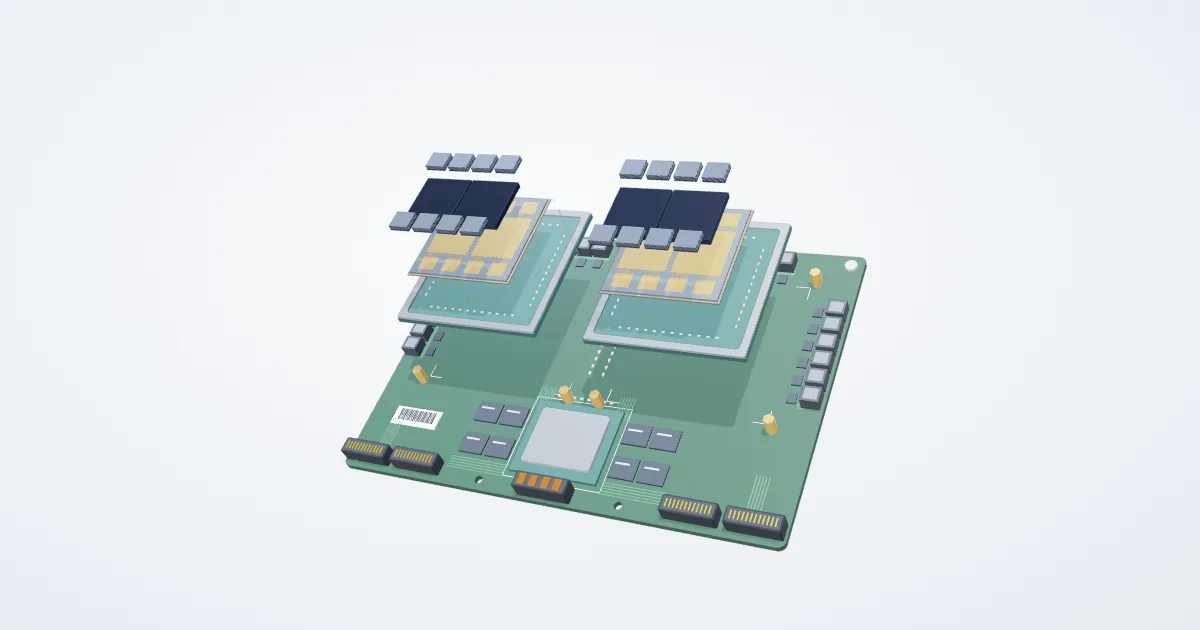
Each Blackwell GPU joins two reticle-limited dies, 208 billion transistors on a custom TSMC 4NP process, and sits beside stacks of HBM on an interposer mounted on an ABF substrate. TSMC packages the dies with CoWoS; SK hynix, Micron and Samsung Electronics make the HBM; and Ibiden and Samsung Electro-Mechanics report substrate demand from AI accelerators. Two GPU packages and one Grace CPU share a superchip module board.
The host side holds the Grace CPUs and their LPDDR5X memory, E1.S NVMe drives and a baseboard management controller; Lenovo’s GB300 guide names ASPEED’s AST2600 as the BMC. The tray motherboard is a high-layer-count, low-loss board, and no source names the fabricator of a specific NVL72 tray.
Reference: NVIDIA: Blackwell architecture.
Switch trays, the copper spine and the optics
Nine switch trays, each with two NVSwitch chips, give every GPU 1,800 GB/s of NVLink bandwidth. Four vertical cartridges at the rear hold over 5,000 copper cables that join the compute and switch trays, with no optics inside the rack; NVIDIA names no cartridge supplier.
Traffic that leaves the rack runs through ConnectX-8 SuperNICs at 800 Gb/s per GPU, then pluggable optical transceivers and fiber to leaf switches from NVIDIA, Arista, Cisco, Celestica or Accton, as the operator chooses. The copper-and-optics guide and the transceiver and copper-cable studies follow these links in detail.
Reference: NVIDIA: GB200 NVL72 designs contributed to OCP (Oct 15, 2024).
Power: shelves, busbar and regulators
Power shelves convert facility AC to about 50 V DC: NVIDIA’s DGX guide lists eight shelves of six 5.5 kW supplies, about 120 kW per rack, and the busbar carries up to 1,400 A to the trays. Voltage regulators on each board then step the voltage down to under 1 V at the chips, surrounded by capacitors and inductors.
NVIDIA says the GB300 power supply, whose capacitors store 65 J per GPU, was co-designed with Lite-On. For later racks NVIDIA plans 800 V DC distribution with its Kyber racks in 2027, and most power-chip makers on its partner lists are named for that generation, not for today’s racks.
Reference: NVIDIA: GB300 NVL72 features for steady power (July 28, 2025).
Cooling: liquid for the chips, air for the rest
Copper cold plates on the GPUs and CPUs carry heat into coolant that flows through rear manifolds and dripless quick disconnects to a coolant distribution unit, which hands the heat to facility water. NVIDIA’s GB200 NVL72 design calls for 120 kW of cooling per rack, and Lenovo’s GB300 guide puts about 90% of the heat into liquid.
The rest leaves by air: in Lenovo’s guide eight dual-rotor fans per compute tray cool the drives, DPU, transceivers and power distribution board, and some sites add a rear-door heat exchanger. The illustrated rack shows an in-rack CDU; many deployments use row-level units instead.
Reference: Lenovo Press: Lenovo NVIDIA GB300 NVL72 product guide.
Explore the illustrative model
The stock3d rack is an interactive 3D model of an NVL72-class system: an educational composite, illustrative, not a bill of materials, and not any vendor’s design. Its company links are curated, not exhaustive, and each rests on a labeled source.
Open a part to see which listed companies are connected to it and on what evidence, from AI-rack evidence to upstream enablers. One illustrated part, the casters and leveling feet, has no verified listed supplier, and it stays a visible gap.