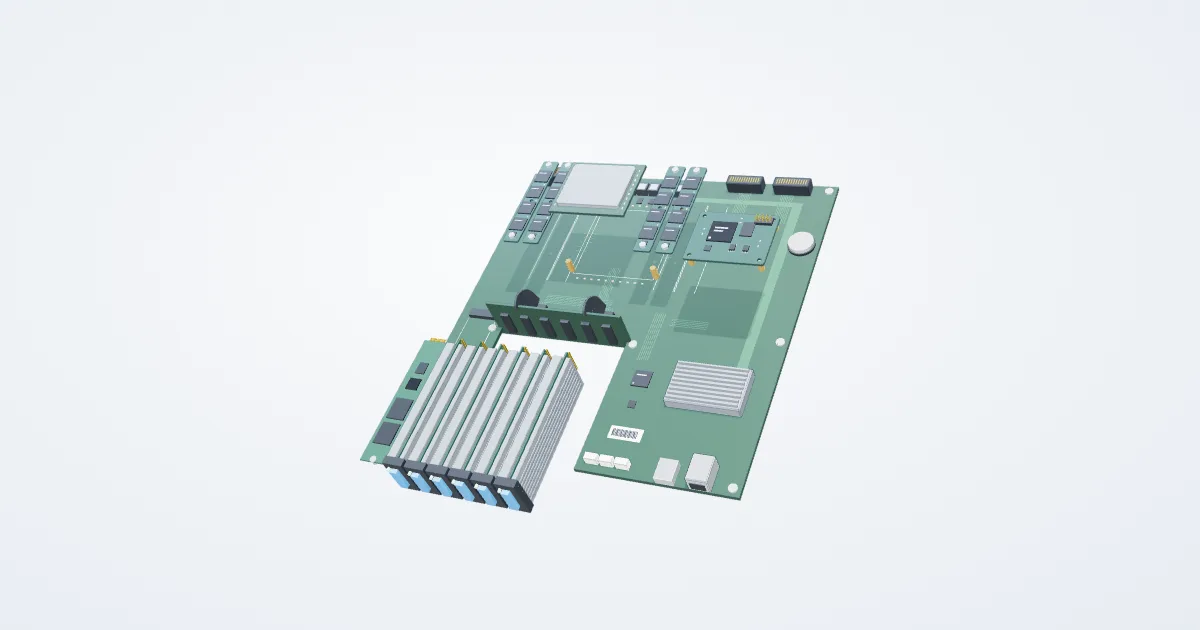
Each compute tray pairs its GPUs with host CPUs that run the operating system and stage data, CPU memory, E1.S flash drives, a management controller and a high-layer-count, low-loss motherboard. A GB200 NVL72 rack carries 36 Grace CPUs with 2,592 Arm cores and up to 17 TB of LPDDR5X (NVIDIA).
A 1U compute tray with its host CPUs, CPU memory, flash drives and a management controller on a high-layer-count motherboard. In the illustrated design, the GPU modules share the tray.
The host CPU runs the system and stages data for the GPUs from its own memory and the flash drives. The management controller watches the tray, and the motherboard carries every signal and current between them.
Illustrative compute tray example. Designs differ by manufacturer; the model is not a bill of materials.
What to look for: The CPU and its memory beside the GPU modules, the drive bays at the front edge, the small management chip, and the thick multilayer board under everything.
Why does a GPU rack need its own CPUs, memory and SSDs?
The GPUs do the math, but something has to run the operating system, move data in and out and coordinate the work. In GB200 NVL72, each Grace CPU sits on the same module as two Blackwell GPUs and brings its own LPDDR5X memory; local E1.S SSDs hold the operating system, caches and checkpoints. The baseboard management controller is separate again: it keeps monitoring power, temperatures and fans even when the host is off.
Is a laminate maker the same as a board maker?
No. Laminate makers such as Elite Material, Shengyi Technology, Taiwan Union and Panasonic (MEGTRON) sell copper-clad laminate and prepreg, the low-loss raw material. Fabricators such as Victory Giant, WUS, Shengyi Electronics, Gold Circuit and TTM press dozens of layers together, drill, plate and test the finished board. We list the first as upstream enablers and the second as board suppliers; no source names either for a specific NVL72 tray.
NVIDIA’s Grace is the reference host CPU, and Micron says its SOCAMM memory was developed with NVIDIA for GB300. Sandisk and Micron name E1.S SSDs qualified for GB200 NVL72, and Lenovo’s GB300 NVL72 product guide names ASPEED’s AST2600 as the tray’s BMC. Victory Giant, WUS and Shengyi Electronics disclose AI-server board revenue, on laminates from makers such as Elite Material and Shengyi Technology.
Open each company below for its source and limitations. Sector membership does not establish a confirmed supply contract.
Inside the assembly
Host CPU
An Arm-based or x86 processor that runs the operating system, stages data and coordinates the GPUs. In rack-scale designs it shares a coherent high-bandwidth link with its GPUs.
Stock-link scope: NVIDIA’s Grace is the host CPU of GB200/GB300 NVL72: a GB200 rack has 36 Grace CPUs with 2,592 Arm Neoverse V2 cores (NVIDIA spec page). Arm licenses the Neoverse cores; in March 2026 it also launched its own AGI CPU silicon. x86 alternatives are AMD EPYC (18 Venice CPUs in AMD’s Helios rack) and Intel Xeon hosts in 8-GPU HGX-class servers. Montage’s Jintide x86 CPUs have no documented AI-rack role and are not mapped.
Low-power LPDDR5X packages or modules beside an Arm CPU, or DDR5 memory modules with interface chips in x86 trays. The GPUs can reach this memory through the CPU.
Stock-link scope: Grace-class CPUs use LPDDR5X (up to 17 TB per GB200 NVL72, NVIDIA). Micron says its SOCAMM LPDDR5X module was developed with NVIDIA for GB300 and was in volume production (Mar 18, 2025); SK hynix reports significantly growing SOCAMM2 sales for AI servers (Q2 2026), and Samsung markets SOCAMM2 with no named platform. x86 trays use DDR5 RDIMMs or MRDIMMs whose interface chips come from Montage (RCD, MRCD/MDB) and Rambus (RCD, PMIC, SPD hub; a SOCAMM2 chipset from Apr 22, 2026); Renesas is sampling a third-generation MRDIMM chipset, with production expected in 2H 2027.
Flash drives in the slim EDSFF E1.S form factor: NAND flash, a controller and DRAM that hold the operating system, checkpoints and cached data. Reference trays carry four; some vendors fit up to eight in internal bays.
Stock-link scope: E1.S NVMe drives sit in each compute tray (NVIDIA lists four per GB200 tray). The rack-specific qualifications found are Sandisk’s DC SN861 E1.S (certified for GB200 NVL72 as Western Digital, Oct 14, 2024) and Micron’s 9550 and 7450 (on NVIDIA’s GB200 NVL72 recommended vendor list, per Micron). Kioxia (NX1 E1.S for GPU servers) and Samsung (PM1763 for AI infrastructure) position drives for AI servers, SK hynix reports expanding eSSD sales for AI servers, and its subsidiary Solidigm, which is not separately listed, shows a cold-plate-cooled SSD. Silicon Motion, Phison and Marvell sell SSD controllers with no named rack program. A vendor list shows eligibility, not volumes.
Also in this part (not publicly listed):Solidigm Subsidiary of SK hynix
Baseboard management controller
A small always-on chip that monitors power, temperature and fans, updates firmware and lets operators reach the tray out of band, often with a hardware root of trust.
Stock-link scope: Lenovo’s GB300 NVL72 product guide names an ASPEED AST2600 as the compute tray’s BMC, and an NVIDIA engineer’s QEMU model of the GB200 NVL72 BMC (July 3, 2025) is built on the same chip; ASPEED targets its 12 nm AST2700 at high-power AI servers. Nuvoton markets its Arbel NPCM8mnx BMC for AI servers with no named customer. BMC share figures (often 70–80% for ASPEED) are broker estimates, not company disclosures. Hyperscalers’ in-house root-of-trust chips are not mapped.
A high-layer-count printed circuit board built on low-loss laminate. It routes high-speed links and heavy power currents between the chips, connectors and power stages.
Stock-link scope: Board fabricators first, then laminate makers (upstream). Victory Giant, WUS and Shengyi Electronics disclose AI-server board revenue or share; Gold Circuit and TTM disclose AI-server or AI-driven data-center boards without naming customers. Elite Material, Shengyi Technology, Taiwan Union and Panasonic (MEGTRON) make the low-loss copper-clad laminate the boards are built on; they are upstream enablers, not board suppliers. No source names the fabricator or laminate of a specific NVL72 tray, and reports that Victory Giant supplies NVIDIA are press claims. Doosan and Kingboard Laminates were not verified.
Disclosed: AMD’s Advancing AI 2026 release describes Helios with 72 MI455X GPUs, 18 Venice CPUs and Pensando networking, and names its adopters and system partners.
Partner-disclosed: NVIDIA’s DGX B300 page names the Intel Xeon 6776P host CPU, and NVIDIA’s Sept 2025 release describes the custom x86 CPU collaboration.
Positioning: Kioxia’s own releases present NX1 E1.S drives for GPU servers and the GP Series for NVIDIA’s Storage-Next initiative; no customer or rack program is named.
Disclosed: Marvell’s FY2026 10-K describes its custom AI silicon, electro-optics DSPs, AEC DSPs for AI scale-up and scale-out, PCIe retimers and Teralynx switches.
Disclosed: Micron’s GTC 2025 release names GB300 NVL72 and GB200 NVL72 for its HBM3E, SOCAMM and SSDs, and its June 2025 release names the AMD MI350 Series.
Disclosed: NVIDIA’s GB300 NVL72 and DGX GB300 pages give the GPU, CPU, NVLink, ConnectX-8, BlueField-3 and NVLink Switch counts, and its FY2026 10-K names its foundry, memory and assembly partners.
Positioning: Rambus’s release presents the SOCAMM2 chipset for AI server platforms without naming a customer; its DDR5 RDIMM chipset is a disclosed data-center product.
Disclosed: Samsung’s GTC 2026 release says its HBM4 is designed for NVIDIA Vera Rubin and in mass production; its Q2 2026 results report scaled-up HBM4 sales.
Disclosed: Western Digital’s Oct 14, 2024 release, issued before the flash business became Sandisk, says the DC SN861 E1.S was certified for NVIDIA GB200 NVL72; Sandisk’s Q4 FY2026 release gives datacenter revenue.
Disclosed: SK hynix’s Q2 2026 results report HBM4 mass shipments and SOCAMM2 growth; NVIDIA’s FY2026 10-K separately names SK Hynix as a memory supplier.
Disclosed: Victory Giant’s July 1, 2026 investor-relations record describes its leading share in AI computing-card, UBB and switch boards; its 2025 annual report gives the results.
Disclosed: TUC’s product pages list its high-speed laminates for servers and switches, and its 2Q26 earnings deck gives the low-loss revenue mix.
Evidence groupings are not investment ratings. Companies may appear in multiple sectors.
Also in this sector (not publicly listed)
Solidigm Subsidiary of SK hynix
SK hynix’s US-based NAND flash and SSD subsidiary (the former Intel NAND business). It shows a fully liquid-cooled SSD solution for AI deployments in which a single spring-loaded cold plate cools both sides of the drive (Apr 1, 2025). Its economics sit inside SK hynix (000660.KS), which reports expanding eSSD sales for AI servers.
US maker of copper-clad laminates and prepregs for multilayer PCBs, including Tachyon 100G and I-Tera MT40 high-speed materials. Its site does not document an AI-server program.