How this system works
A single-plate surface-relief waveguide with the three usual grating zones, between a front cover lens and a rear prescription lens. Grating periods are sub-wavelength (about 300-600 nm), so the ridges and light paths here are exaggerated teaching aids. Meta Ray-Ban Display uses a geometric (reflective) waveguide instead.
The in-coupler bends the projector’s light steeply enough to be trapped by total internal reflection. It bounces along the plate; the fold grating spreads it sideways and the out-coupler releases a little at each bounce toward the eye.
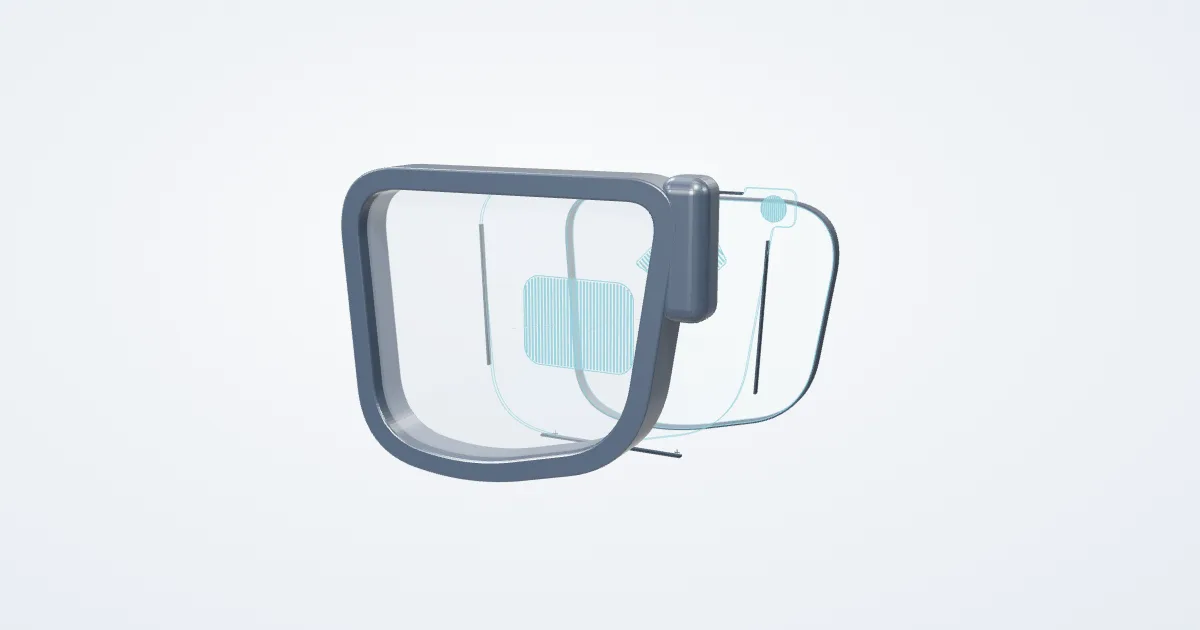
What to look for: The small grating hidden under the frame corner, the fanned light path, and the larger patch in front of the pupil.
Compare the right roles
Reflective, diffractive or birdbath?
Reflective (geometric) waveguides embed partial mirrors in glass; Lumus designs them, and Crystal-Optech and Quanta have agreements to manufacture them. Diffractive waveguides use nanoscale gratings made by imprint or etch (Applied Materials, Vuzix). Birdbath optics use a beam splitter and a curved mirror instead of a waveguide. A maker of one architecture is not a supplier of the others.
Is a wafer supplier a waveguide maker?
No. Corning, AGC, HOYA, Mitsui Chemicals, Coherent and SICC make or market high-index glass, polymer or silicon-carbide wafers, and others pattern and assemble them into waveguides. They are listed as upstream enablers, and none names a shipping glasses program in our sources.
Applied Materials provides the etched waveguide in RayNeo X3 Pro and has a waveguide R&D agreement with EssilorLuxottica. Crystal-Optech and Quanta have agreements with Lumus to manufacture its reflective waveguides, and AUO makes waveguides for AR-glasses modules. Corning, AGC, HOYA, Mitsui Chemicals, Coherent and SICC make or market the high-index wafers upstream. Lumus and SCHOTT AG are private.
Open each company below for its source and limitations. Sector membership does not establish a confirmed supply contract.
Inside the assembly
Front cover lens
The world-side lens protects the gratings and can darken outdoors (photochromic or electrochromic). An air gap keeps total internal reflection working in the plate behind it.
Stock-link scope: EssilorLuxottica supplies the lenses for Ray-Ban Meta, Oakley Meta and Meta Glasses, including Transitions photochromic lenses (EssilorLuxottica releases, Sept 18, 2025 and June 23, 2026). Snap describes electrochromic lenses in Specs; electrochromic dimming suppliers (Snap Specs, Xiaomi, XREAL) are not identified.
In-coupling grating
A small grating under the projector’s exit pupil diffracts the image steeply enough to be trapped in the plate. It sits under the frame corner, out of the wearer’s view.
Stock-link scope: Diffractive waveguide makers whose products integrate the couplers: Applied Materials (single-layer etched waveguide in RayNeo X3 Pro, per JBD and RayNeo) and Vuzix (nano-imprinted waveguides). Lumus manufacturers Crystal-Optech and Quanta make reflective waveguides with mirror facets, not gratings, so they stay at sector level, as does AUO until its waveguide type is documented. Goertek’s waveguide business sits in Goertek Optical, a non-consolidated 38.34% associate since Dec 2025, so Goertek is not mapped.
Also in this part (not publicly listed): Dispelix Not publicly listed, DigiLens Not publicly listed
High-index waveguide plate
Light bounces along the plate by total internal reflection. A higher index allows a wider field of view: optical glass is about 1.8-2.0, silicon carbide about 2.6-2.7.
Stock-link scope: Upstream wafer suppliers that market high-index glass, polymer or SiC for AR waveguides. SICC reports initial AR/VR use with unnamed optics customers, still in customer validation; none names a shipping glasses program. The reflective waveguide glass in Meta Ray-Ban Display is reportedly SCHOTT’s (private).
Also in this part (not publicly listed): SCHOTT AG Not publicly listed
Fold / exit-pupil expander
A second grating turns the guided light and copies it sideways, so the image fills a larger eyebox.
Stock-link scope: Same diffractive waveguide makers; the grating is part of the complete waveguide, not a separately sold component.
Also in this part (not publicly listed): Dispelix Not publicly listed, DigiLens Not publicly listed
Out-coupling grating
The last grating releases part of the light toward the eye at every bounce. Ambient light diffracting off the gratings causes rainbow artifacts, and some image light leaks forward.
Stock-link scope: Same diffractive waveguide makers. Reflective (geometric) waveguides use partially reflective facets instead.
Also in this part (not publicly listed): Dispelix Not publicly listed, DigiLens Not publicly listed
Prescription lens
Vision correction sits on the eye side, bonded to the waveguide or as a removable insert. This is a minus lens, thicker at the edge.
Stock-link scope: Prescription lenses for Meta glasses come through EssilorLuxottica (Ray-Ban Meta Gen 2 with individual prescription lenses; three Rx-able Meta Glasses styles). HOYA Vision Care and other ophthalmic lens makers have no disclosed smart-glasses program in our sources.