| Panel | How it makes the image | Research distinction |
|---|---|---|
| LCoS | A liquid-crystal layer on a silicon backplane modulates light from separate LEDs, sorted by a polarizing beam splitter | Teardown-identified in Meta Ray-Ban Display (OmniVision). Himax and Kopin market LCoS-type panels with no named current consumer-glasses customer. |
| Micro-OLED (OLEDoS) | Organic LEDs on a silicon backplane emit light pixel by pixel | Sony, BOE and SeeYA make these panels. SeeYA’s prospectus names its displays in RayNeo Air3 glasses; RayNeo is not publicly listed. |
| MicroLED | Inorganic LEDs on a silicon backplane emit light pixel by pixel | JBD, named in the RayNeo X3 Pro release, is not publicly listed. Kopin lists microLED among its microdisplays. |
| DLP or laser scanning | Tiny mirrors or a scanned laser beam form the image | Used in some near-eye designs. No maker of these engines is connected to the stock3d glasses model. |
Two jobs: make the image, then place it
See-through display glasses split the task in two. A light engine near the hinge makes a tiny image, and a combiner in the lens carries that image in front of the eye while the world stays visible. Panel makers and combiner makers are usually different companies.
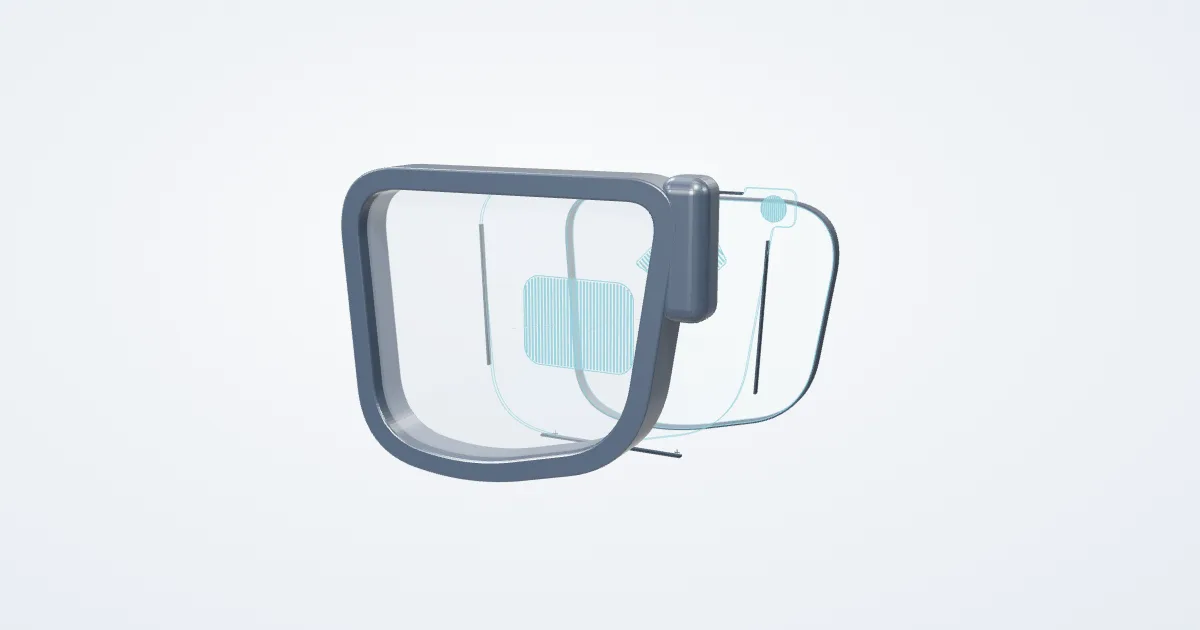
In a waveguide, the image enters the lens at an in-coupler, travels inside the plate by total internal reflection, and leaves toward the eye across a wider area so the eye can move and still see it. The stock3d model illustrates an LCoS engine with a diffractive waveguide as one example architecture.
Microdisplays: LCoS, micro-OLED and microLED
LCoS panels do not emit light. LEDs illuminate a liquid-crystal layer on a silicon chip, and a polarizing beam splitter passes on only the light from switched-on pixels. Himax says its front-lit LCoS balances size, weight, resolution, power and cost for AR glasses, and it planned CES 2026 demonstrations with AUO and Vuzix waveguides.
Micro-OLED and microLED panels emit their own light. Sony’s ECX350F, a 0.44-inch Full HD OLED microdisplay designed for AR glasses, is rated at up to 10,000 cd/m² (Sony, Sept 2024). MicroLED is used where very high brightness from a very small panel matters: the RayNeo X3 Pro release cites up to 6,000 nits at the eye from a JBD microLED panel and an Applied Materials waveguide.
Reference: Himax: CES 2026 showcase (Jan 2, 2026).
Combiners: reflective, diffractive, holographic and birdbath
A reflective, or geometric, waveguide embeds partially reflective surfaces in glass. Lumus, which is not publicly listed, designs this type and names Quanta Computer, SCHOTT AG and, since September 2026, Zhejiang Crystal-Optech as manufacturers of its geometric waveguides. Teardowns of Meta Ray-Ban Display describe a Lumus-type reflective waveguide.
A diffractive waveguide uses nanoscale gratings to bend light into and out of the plate. Applied Materials provides the single-layer etched diffractive waveguide in RayNeo X3 Pro, and Vuzix makes nano-imprinted waveguides. Holographic combiners record the grating inside a material layer instead, and birdbath optics place a beam splitter and curved mirror in front of the panel. A maker of one architecture is not a component maker for another.
Reference: Lumus: manufacturing agreement with Crystal-Optech (Sept 9, 2026).
Panel brightness is not brightness at the eye
A panel’s rating and the brightness a wearer sees are different numbers, because the combiner delivers only part of the light to the eye. KGOnTech reports a measurement of about 1 lumen leaving the Meta Ray-Ban Display projector and says it confirmed Meta’s claim of about 5,000 nits at the eye.
Compare like with like: luminance at the panel, lumens out of the engine, or nits at the eye. KGOnTech also writes that reflective waveguides are typically three to seven times more efficient than diffractive ones for the same field of view and eyebox. That is an analyst’s assessment, not a measured comparison of named products.
Reference: KGOnTech: Meta Ray-Ban Display, part 1 (Oct 30, 2025).
One display or two
Meta Ray-Ban Display has one display, in the right lens. A binocular design needs two light engines and two waveguides, which doubles that content per device and adds power and heat inside the frame.
The stock3d model shows displays in both lenses to illustrate the binocular case. It does not assume that a future binocular model would use the same panel, waveguide or engine makers; each connection needs its own teardown or disclosure.
Reference: EssilorLuxottica: new AI glasses with Meta (Sept 18, 2025).
Materials and manufacturing
A higher refractive index lets a waveguide carry a wider field of view. Meta says silicon carbide, used in its Orion product prototype, has a refractive index of about 2.7 and supports a field of view of about 70 degrees. Mitsui Chemicals markets Diffrar polymer wafers at indices of 1.67 and 1.74; AGC and HOYA market high-index glass for AR/MR waveguides; and Corning lists glass wafers for augmented reality among its products.
Gratings are either etched into the plate or nano-imprinted into a resin layer. The RayNeo X3 Pro release describes the Applied Materials waveguide as etched, and Vuzix describes volume-production nano-imprinting. Wafer makers sell the substrate; stock3d lists them as upstream enablers, not waveguide makers, unless they disclose a finished waveguide.
Reference: Meta: silicon carbide waveguides in Orion (Mar 6, 2025).
What it means for company research
Match the architecture before matching the company. In stock3d, the illustrated grating parts link only to diffractive waveguide makers and the LCoS panel only to LCoS makers. Reflective-waveguide manufacturers and micro-OLED makers stay at sector level, with a sentence explaining why.
Then check the evidence level. A teardown identifies a part in one unit; a marketed panel or wafer may have no named customer; a license or joint development agreement sets up a relationship without disclosing volumes. The waveguide and microdisplay sector pages list the connected companies and their sources.