| How we know | What it shows | What it does not establish |
|---|---|---|
| Teardown-verified | An independent teardown firm names the part in a unit it opened | Price, volume, exclusivity or use in the next model |
| Disclosed | The company’s own filing, release or product page describes a glasses role | Customers it does not name, or glasses revenue it does not report |
| Partner/OEM-disclosed | A named partner’s or device maker’s document names the company | Scale beyond the named product |
| Positioning | A dedicated glasses product or application page with no named customer | That shipping glasses use the part |
| Analyst-attributed | An expert’s inference, for example from a patent or design cues | Anything on its own; it cannot set an evidence category |
| Reported, unconfirmed | Press reports citing unnamed sources | Anything; shown only as a labeled caveat with outlet and date |
Start with the product family
“Smart glasses” covers three different products. Camera-and-audio glasses have no display. Monocular display glasses add one small display. Binocular AR glasses put an image in front of both eyes. Each step adds a light engine, a waveguide and more power demand, so the relevant component makers change with the family.
The families are not the same size. In Counterpoint’s H1 2026 count of AI glasses, display-less models were 96% of shipments. Name the family before comparing a waveguide maker with a camera-sensor maker.
Reference: Counterpoint Research: AI glasses shipments, H1 2026 (Sept 21, 2026).
Follow the evidence to its original source
Open the teardown, filing, partner release or product page behind a claim. Check whether it names smart glasses explicitly, a headset or other near-eye display, or only a general wearable part, and keep that qualifier attached when you summarize the connection.
stock3d uses four labels for smart glasses: Smart-glasses evidence, XR products, Adjacent technology and Upstream enabler. For a device maker, Smart-glasses evidence means its own glasses, not a supply role. Each listing also shows how the evidence is known, as in the table above. The labels describe specificity, not investment quality.
Separate the brand, the platform and the component maker
One launch can involve several companies with different roles. Warby Parker’s May 2025 filing describes a partnership with Google to develop intelligent eyewear on Android XR. Google committed up to $75 million for product development and commercialization costs and up to $75 million in equity, at Warby Parker’s option and subject to collaboration milestones.
That describes a design and platform partnership. It does not say who makes the chips, displays or optics. stock3d lists device makers and platforms in their own sector and places one under a physical part only with separate evidence, such as EssilorLuxottica for frames and lenses.
Reference: Warby Parker: partnership with Google, SEC exhibit 99.1 (May 20, 2025).
Identify the listed business you would own
Check the issuer, exchange and ticker together. EssilorLuxottica trades in Paris and has an unsponsored OTC ADR, ESLOY; the US symbol EL belongs to Estée Lauder. The code 2382 is Quanta Computer in Taiwan and Sunny Optical in Hong Kong. stock3d treats a US line as verified only when it appears in Nasdaq’s exchange directories, or as an active depositary receipt in Citi’s directory that also returns a quote.
Then check ownership. Goertek reports its optics business, Goertek Optical, as an associate rather than a subsidiary. Several important component makers, including Lumus, SCHOTT AG, JBD and Syntiant, are not publicly listed. stock3d names them but never substitutes a listed investor or partner for them.
Reference: Nasdaq Trader: symbol directory definitions.
Check how concentrated demand is
Each research firm we cite puts Meta far ahead, under its own definition: IDC at 68.7% of XR headset and glasses shipments in Q2 2026, Omdia at 81.3% of AI glasses in 1H26, and Counterpoint at 94% of display-less AI glasses in H1 2026. These measure different markets and should not be averaged or combined.
For a component maker, a position in Meta’s glasses can be significant, and one redesign can change it. Most teardown-identified parts in stock3d come from a single device, Meta Ray-Ban Display, so treat each new teardown as a research event.
Reference: Omdia: AI glasses shipments, 1H26 (via Business Wire, Sept 23, 2026).
Separate sampling from shipping, and focus from scale
A license, a sample, a reference design and recurring production are different milestones. Enovix reported shipping about 2,100 silicon-anode battery packs in Q2 2026 under a 50,000-pack order for 2026 delivery to support what it calls a leading smart-eyewear reference platform. The customer is unnamed, and Enovix described the initial revenue as modest.
Focus is not scale. Vuzix is a listed specialist in smart glasses and waveguides, but its total revenue in Q2 2026 was $1.1 million, down 14% from a year earlier (Vuzix results, Aug 13, 2026). Check revenue, costs and funding needs separately from the strength of the evidence.
Reference: Enovix: Q2 2026 results, SEC exhibit 99.1 (Aug 12, 2026).
Read market data with its definition
IDC, Counterpoint and Omdia define the market differently. IDC tracks eyewear with displays in its AR/VR segment and builds its share tables from its wearables and AR/VR headset trackers together. Counterpoint counts AI glasses that have an AI-enabled processor and at least two of speakers, microphones, cameras and AR displays. Quote each figure with its firm, period and definition.
Unit shipments are not component revenue. A shipment count does not reveal a part’s price, its share of the bill of materials or which companies are inside. The market guide lists the latest figures firm by firm.
Reference: IDC: smart glasses market share, Q2 2026 (Sept 16, 2026).
Use the model as a research starting point
Choose a sector, inspect how its parts work, and open a company’s evidence record. Compare the product role, the evidence basis, the business mix and the caveat. Follow the source before moving into deeper financial research on Yahoo Finance or Fynca.
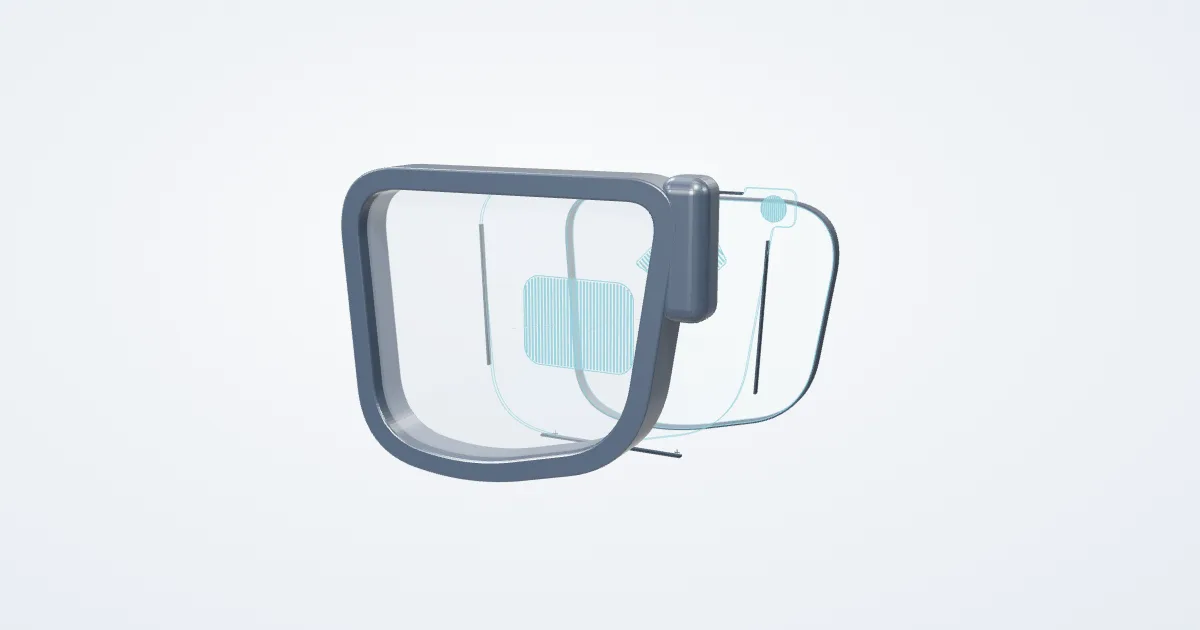
The glasses model is an illustrative composite, not a bill of materials, and its company links are curated, not exhaustive. Nine illustrated parts have no verified listed supplier. Those gaps stay visible; adding loosely related names would not make a connection more accurate.