How this system works
A long, narrow HDI board shaped to the temple carries an AR-class SoC with stacked memory, flash, and the radio, IMU, power and audio chips. A graphite sheet spreads heat into the temple. KGOnTech measured about 0.38 W for display plus audio and about 1.7 W while recording video on Meta Ray-Ban Display.
The SoC runs the camera pipeline, on-device AI, audio and display timing within about 1-2 W. Memory sits on it, a low-power co-processor handles always-on tasks, and a graphite sheet spreads the heat into the frame.
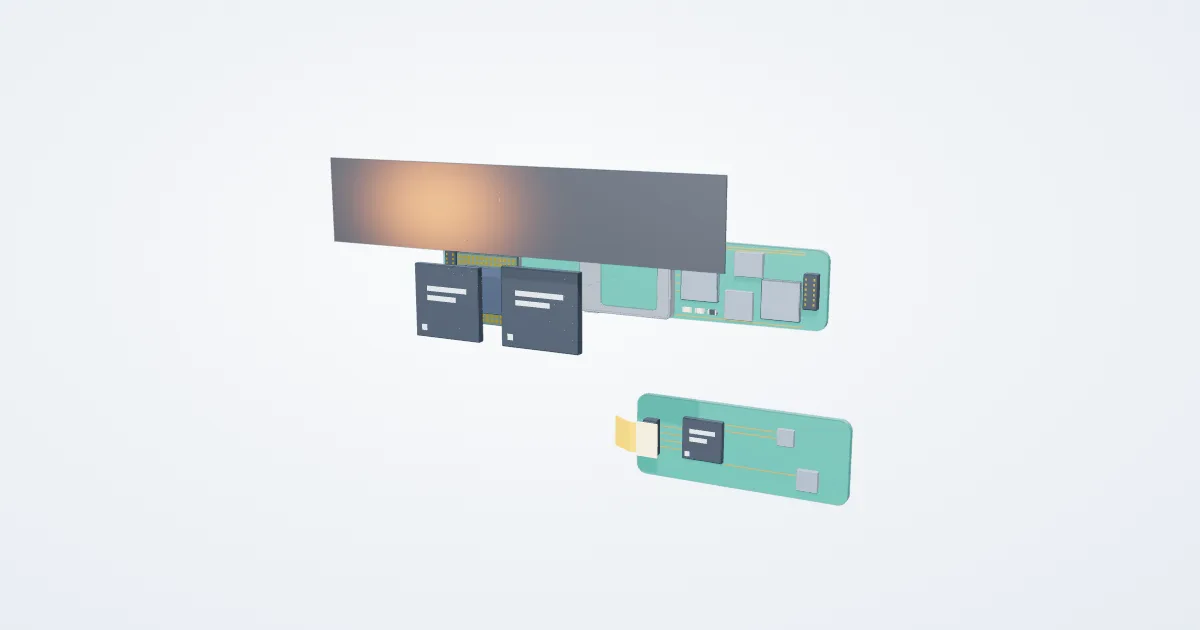
What to look for: The memory stacked on the processor under a shield can, the separate small co-processor board and the heat spreader above.
Compare the right roles
Why do many glasses use two processors?
A glasses chip such as Snapdragon AR1 handles the camera, on-device AI and display, but it cannot stay awake all day within the battery budget. A low-power companion chip listens for the wake word and runs Bluetooth audio so the main chip can sleep.
Who makes the memory?
Meta Ray-Ban Display carries 2 GB of LPDDR4X and 32 GB of flash, but teardowns do not name the vendors. BIWIN’s filings say Meta and other device makers use its products in AI glasses and smartwatches; Meta has not confirmed. Micron markets memory for AR glasses without a named customer.
Snapdragon AR1 Gen 1 from Qualcomm is teardown-verified in Meta Ray-Ban Display and Oakley Meta HSTN. Bestechnic and Actions report glasses chips in mass production, NXP markets its i.MX RT processors for AI glasses, and BIWIN says its ePOP memory is used in AI glasses.
Open each company below for its source and limitations. Sector membership does not establish a confirmed supply contract.
Inside the assembly
HDI temple logic board
A narrow any-layer HDI board routes power and high-speed signals inside the temple’s cross-section; its outline largely sets how tall the temple must be. The radio, IMU, power and audio chips share it.
Stock-link scope: GAP: no listed HDI board fabricator is verified for glasses. ODMs (Goertek, Luxshare) integrate the board and are listed under Frames & assembly, not as board makers.
No verified direct company match in the current universe.
AR SoC
An AR-class SoC such as Snapdragon AR1 Gen 1 runs the camera ISP, on-device AI, audio and display timing. With no fan and skin contact, sustained power stays around 1-2 W.
Stock-link scope: Snapdragon AR1 Gen 1 is teardown-verified in Meta Ray-Ban Display (TechInsights) and Oakley Meta HSTN (iFixit) and named in Samsung’s and Rokid’s releases. Bestechnic and Actions sell dedicated glasses SoCs and report glasses mass production in their 2025-26 filings. Arm licenses the CPU/NPU IP (Arm calls Meta’s Ray-Ban glasses Arm-based); it does not make chips.
LPDDR memory & flash
Working memory, stacked on the SoC here, plus flash for photos, video and software. Meta Ray-Ban Display pairs 2 GB of LPDDR4X with 32 GB of flash.
Stock-link scope: BIWIN’s 2025 annual report and 2026 interim report say Meta and others use its ePOP in AI/AR glasses and smartwatches (supplier filing; Meta has not confirmed). Micron markets memory for AR glasses with no named customer. AR1 Gen 1 supports LPDDR4x (Qualcomm brief). The memory vendors in teardown Meta glasses are unidentified, so SK hynix, Samsung and Kioxia are not mapped.
Low-power co-processor
An always-on chip handles the wake word, Bluetooth audio and sensor duties so the main SoC can sleep; Bestechnic BES2700/BES2800 and NXP RT600 are named examples. Here it sits on a small board in the other temple.
Stock-link scope: Always-on MCUs, audio SoCs and bridging FPGAs: Bestechnic BES2700/2800 beside AR1 in Xiaomi and Quark glasses (launch coverage, not OEM spec pages); NXP i.MX RT600 beside AR1 in Rokid Ai Glasses Style (Rokid releases, Jan 2026); Actions glasses SoCs in mass production at unnamed brands; Nordic nRF52840 in Blucap Moto HUD sunglasses and ViXion01S (Nordic releases); Nordic and Lattice CrossLink-NX in Brilliant Labs Frame (sold out; its successor Halo uses a private Alif chip); ST STM32 (catalog positioning).
Graphite heat spreader
A thin graphite sheet spreads heat from the SoC along the temple, so no spot gets too hot against the skin.
Stock-link scope: GAP: no listed graphite-sheet or thermal-interface supplier is verified for glasses. Glasses use passive spreaders rather than fans.
No verified direct company match in the current universe.