Processors, licensed processor architecture, memory, software, power delivery, and cooling all contribute. A processor vendor should not automatically be described as a memory or heat-sink manufacturer.
Is every robotics controller an onboard AI computer?
No. Factory motion controllers, onboard inference modules, simulation software, and training infrastructure serve different purposes. Read the specific product role before comparing companies.
NVIDIA stands out for its integrated hardware, simulation, and model stack. Qualcomm and AMD provide alternative embedded and adaptive computing platforms.
Open each company below for its source and limitations. Sector membership does not establish a confirmed supply contract.
Inside the assembly
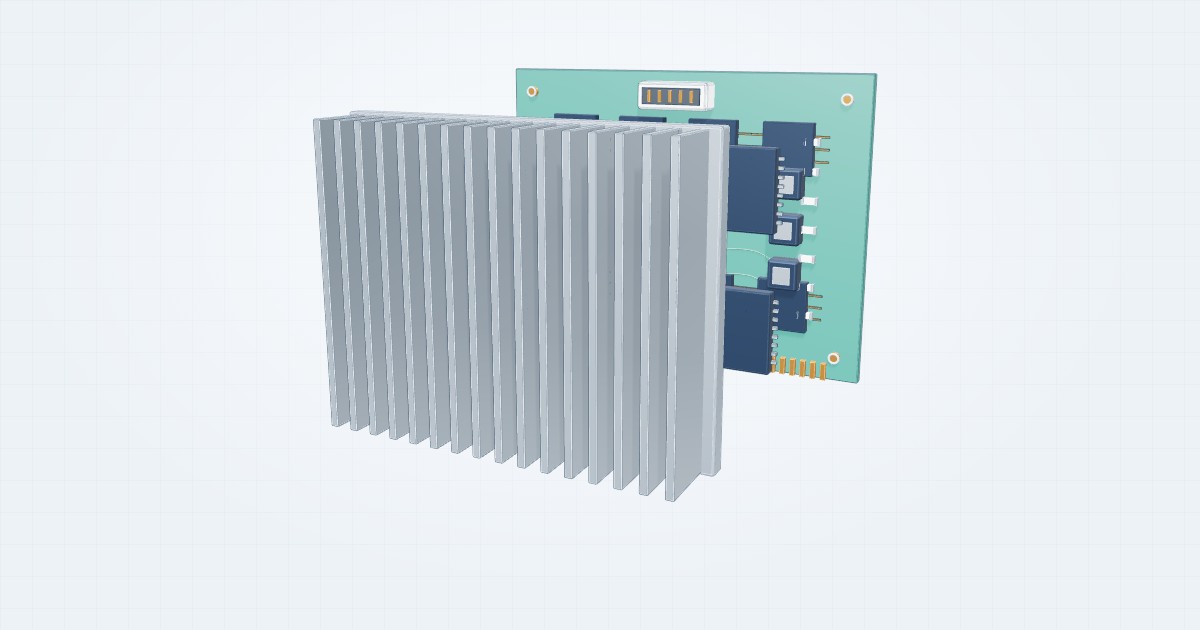
Compute carrier board
The circuit board routes power and high-speed signals between compute, memory, and peripherals.
Stock-link scope: Compute modules and reference platforms, plus board interconnects (Amphenol) and power electronics (MPS). Not bare-PCB fabrication.
The main processor executes perception and planning. Real-time control can run on separate processing cores or devices.
Stock-link scope: AI processors and embedded real-time controllers serve different workloads. Arm licenses processor IP; it does not manufacture chips.
Memory holds the working data used by perception and control; nonvolatile storage retains software and models. Capacity, bandwidth, and power consumption affect performance.
Stock-link scope: Memory manufacturers only. Micron explicitly discusses humanoids; Samsung and SK hynix are adjacent low-power memory exposure.
A metal heat spreader and fins carry heat away from the processor so it can sustain performance.
Stock-link scope: SUNON supplies fans and thermal modules for robotic cooling. Processor and computer vendors are not treated as cooling-component makers.
Jetson Thor and the Isaac/GR00T stack explicitly target humanoids, with named robot developers. NVIDIA is not a DRAM or standalone heat-sink manufacturer.
Humanoid reference designs cover motor drives, BMS, sensing, controllers, and multi-axis hand control. TI supplies chips, not complete mechanical hands.
AMD documents processors, adaptive compute, and Kria robotics modules. Embedded processing is the relevant role, not memory-chip or heat-sink manufacturing.
Ennoconn lists robotics and digital-twin systems integration. This is broader automation software/hardware exposure, not verified onboard humanoid silicon.