How this system works
A rack of room-temperature control electronics: waveform generators, microwave sources and mixers, FPGA controllers and readout digitizers, with a GPU server that decodes error correction beside them.
Waveform generators draw each pulse, microwave sources and mixers move it to the qubit frequency, FPGA controllers set the timing and react to results, digitizers capture the readout, and the server decodes errors as the machine runs.
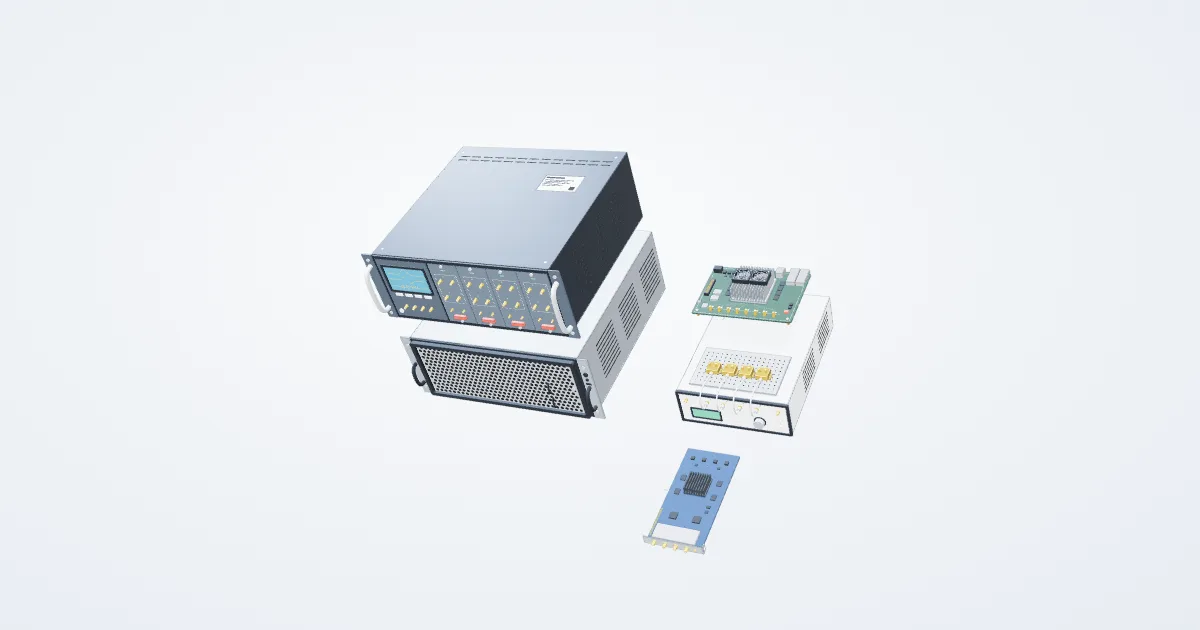
What to look for: The rows of output connectors on the waveform generators, the mixer and synthesizer modules, the FPGA board and its heat sink, the digitizer card, and the GPU server at the bottom of the rack.
Compare the right roles
Why does error correction need FPGAs or GPUs next to a quantum computer?
Error correction measures parity checks round after round, and a decoder must work out which errors occurred before the next rounds pile up; in superconducting machines those rounds run on microsecond timescales. The fastest decoders run on FPGAs beside the controller: IBM Quantum’s prototype on an AMD XCVU19P reaches a 24-nanosecond iteration time, enough for under 1 microsecond per cycle on average. Heavier decoders run on GPU servers over low-latency links such as NVIDIA’s NVQLink, which Quantinuum used for real-time decoding with a 67-microsecond reaction time.
Are the companies that build qubit controllers listed?
Mostly not. Quantum Machines, Qblox, QuEL, Riverlane, Intermodulation Products and Spectrum Instrumentation are private, and Zurich Instruments belongs to the privately held Rohde & Schwarz. Keysight is the listed company that sells a complete quantum control system; the other listed names here supply chips inside controllers (AMD, Analog Devices, Texas Instruments), decoding and host platforms (NVIDIA, HPE) or general lab instruments (Tektronix under Ralliant, Anritsu, Teledyne SP Devices).
Keysight sells a complete quantum control system, embedded in a 256-qubit computer in Japan, while Tektronix (Ralliant), Anritsu and Teledyne’s SP Devices position lab instruments for qubit work. AMD RFSoCs and FPGAs sit inside controllers from the private Zurich Instruments and Quantum Machines and in an FPGA error-correction decoder prototype, and the private QuEL’s controller uses Analog Devices converters and mixers with Texas Instruments synthesizers. NVIDIA’s NVQLink links controllers to GPU decoders, and HPE is integrating quantum systems with its supercomputers.
Open each company below for its source and limitations. Sector membership does not establish a confirmed supply contract.
Inside the assembly
Waveform generators
Arbitrary waveform generators and fast digital-to-analog converters that synthesize the nanosecond pulses of every gate.
Stock-link scope: Keysight sells complete RF AWG modules (four-channel M5300A, DC–16 GHz) in its Quantum Control System, installed in a 256-qubit computer in Japan. Many controllers now synthesize pulses directly with RF data converters: AMD RFSoCs in the open-source QICK and in Zurich Instruments’ QCCS, and Analog Devices AD9082s in QuEL’s QuBE. Tektronix (Ralliant) markets its AWG5200 for superconducting-qubit control without a named customer. Zurich Instruments, Qblox, QuEL, Intermodulation Products and Spectrum Instrumentation are private. Texas Instruments’ bias DACs in QICK set DC flux levels rather than pulses, so TI is mapped under microwave sources instead. QuantumCTek’s ez-Q Engine measurement and control system (8 drive and 2 readout channels per unit) serves the Zuchongzhi superconducting computers, per its own product pages.
Also in this part (not publicly listed): Zurich Instruments Subsidiary of Rohde & Schwarz (private), Qblox Not publicly listed, QuEL Not publicly listed, Intermodulation Products Not publicly listed, Spectrum Instrumentation Not publicly listed
Microwave sources & mixers
Local oscillators, synthesizers and IQ mixers that move pulses up to the qubits’ 4–8 gigahertz band and bring the readout signal back down.
Stock-link scope: Keysight’s QCS includes M5201A down converters (2–16 GHz input) alongside AWGs that output directly up to 16 GHz. In QuEL’s QuBE, Analog Devices ADRF6780 mixers and Texas Instruments LMX2594 synthesizers move 1.25–3.25 GHz waveforms up to the 7.25–10 GHz drive band, and QICK’s RF boards use ADI ADF4372 or TI LMX2594 local oscillators. Anritsu positions its signal generators as qubit-control local oscillators, with lab use documented at AIST. Controllers that synthesize microwaves directly need fewer mixers. Zurich Instruments’ SHFSG+ signal generators and QuEL’s front end are private.
Also in this part (not publicly listed): Zurich Instruments Subsidiary of Rohde & Schwarz (private), QuEL Not publicly listed
FPGA controllers
Field-programmable gate arrays, often RF system-on-chip devices with converters on board, that sequence pulses, read results and feed back within microseconds.
Stock-link scope: AMD is the only FPGA vendor named inside qubit controllers in the sources checked: Zynq UltraScale+ RFSoCs in QICK and Zurich Instruments’ QCCS, Virtex UltraScale+ and Versal Premium devices in Zurich Instruments’ system controller, Alveo U50 boards in QuEL’s QuBE, and AMD FPGAs credited by Quantum Machines. The sequencer logic is designed by the controller makers, which are private. Keysight and Qblox do not name their FPGA vendors in the sources opened, and no Intel/Altera, Microchip or Lattice design-in was found, so none is mapped.
Also in this part (not publicly listed): Quantum Machines Not publicly listed, Zurich Instruments Subsidiary of Rohde & Schwarz (private), Qblox Not publicly listed, QuEL Not publicly listed
Readout digitizers
Fast analog-to-digital converters that capture and demodulate the readout signals, turning them into qubit measurement results.
Stock-link scope: Keysight’s QCS uses M5200A digitizers (four 2 GHz, 12-bit channels) behind M5201A down converters. RF-sampling ADCs increasingly do the job inside controllers: AMD RFSoCs capture readout in QICK and Zurich Instruments’ QCCS, and each AD9082 in QuEL’s QuBE adds two 6 GSPS ADCs. Teledyne SP Devices documents its ADQ digitizers in superconducting-qubit readout research at Royal Holloway, University of London. Zurich Instruments (SHFQA+ analyzers), Qblox, QuEL, Intermodulation Products and Spectrum Instrumentation are private. QuantumCTek’s ez-Q Engine includes readout channels, per its product pages.
Also in this part (not publicly listed): Zurich Instruments Subsidiary of Rohde & Schwarz (private), Qblox Not publicly listed, QuEL Not publicly listed, Intermodulation Products Not publicly listed, Spectrum Instrumentation Not publicly listed
Decoder & host server
A GPU and CPU server that calibrates the machine, compiles programs and decodes quantum error-correction syndromes in real time.
Stock-link scope: Real-time decoding runs on FPGAs beside the controller or on GPU/CPU hosts. NVIDIA’s NVQLink and CUDA-Q QEC link controllers to GPU servers with round trips under 4 µs, and Quantinuum decoded qLDPC codes in real time on its Helios processor through NVQLink. IBM Quantum designed a Relay-BP decoder prototype on an AMD XCVU19P FPGA (Oct 2025). HPE is integrating quantum processors, controllers and decoders with its Cray supercomputers in research testbeds. Riverlane, whose Deltaflow 2 decoders are integrated with Qblox control hardware, is private.
Also in this part (not publicly listed): Riverlane Not publicly listed