| System | What it does | A documented figure | Examples of connected companies |
|---|---|---|---|
| Qubit chips & packaging | A die of transmon qubits, couplers and readout resonators, bonded, packaged and shielded | 120 qubits and 218 tunable couplers in Nighthawk (IBM) | IBM, Alphabet, Rigetti, IQM, Fujitsu, Oxford Instruments |
| Dilution refrigerator | Five cold stages; helium-3 dilution provides the last step to about 10 mK | 19 µW of cooling at 20 mK on the coldest stage (ETH Zurich) | ULVAC, QuantumCTek, FormFactor, Nippon Sanso, Air Liquide |
| Cryocoolers & helium | A pulse tube, driven by a helium compressor, pre-cools the stages to a few kelvin | 2.0 W at 4.2 K from SHI’s highest-capacity 4 K pulse tube | Sumitomo Heavy Industries, ULVAC, Linde, Air Products, ExxonMobil |
| Cryogenic wiring & filters | Coaxial and flex lines with attenuators and filters at every stage | 124 RF lines for a 50-qubit processor (ETH Zurich) | Huber+Suhner, Amphenol, JAE, Hirose, QuantumCTek |
| Readout amplifiers & isolators | A parametric amplifier at 10 mK, a HEMT at 4 K and amplifiers at room temperature | Readout pulses of about −130 to −120 dBm (AIST roadmap) | Amphenol, AmpliTech, QuantumCTek |
| Control electronics | Waveform generators, converters and FPGAs, with a GPU server that decodes errors | Under 4 µs from FPGA to GPU and back (NVIDIA NVQLink) | Keysight, AMD, Analog Devices, Texas Instruments, NVIDIA |
| Vacuum & gas handling | Pumps, valves and gauges that circulate the helium-3/helium-4 mixture | 40,000 liters of world helium-3 output in 2025 (USGS estimate) | Pfeiffer Vacuum, Atlas Copco, Agilent, VAT Group, Air Liquide, Linde |
A quantum computer is mostly cryogenics and cabling
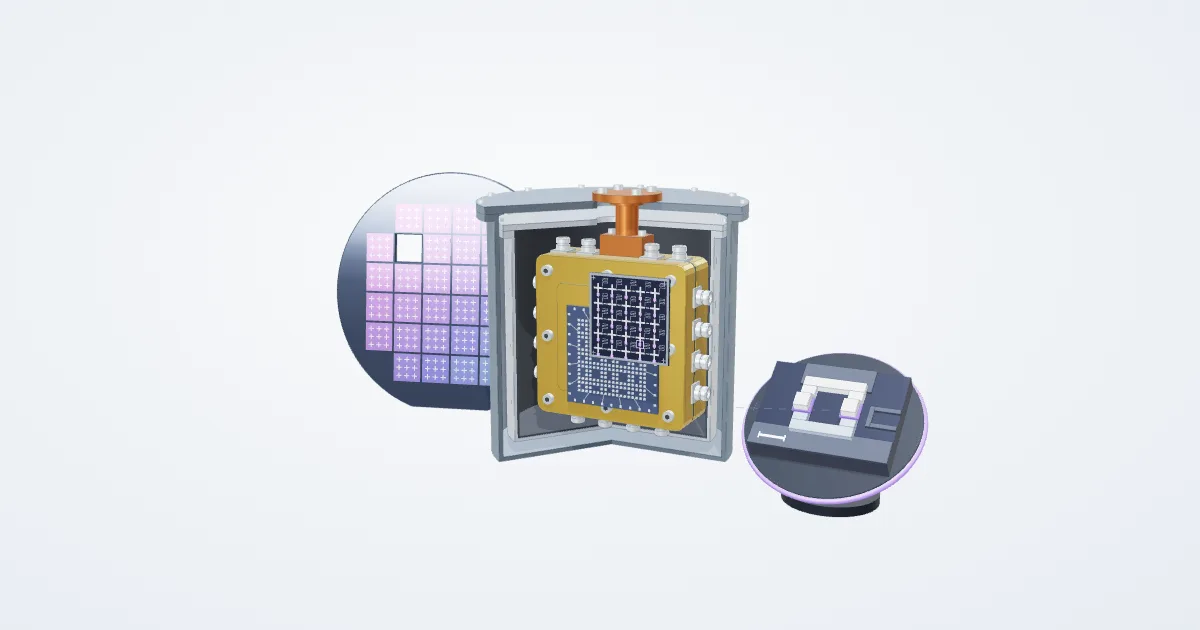
The qubits sit on one small chip; almost everything else in a superconducting quantum computer exists to keep that chip cold, quiet and connected. IBM’s Nighthawk links 120 qubits with 218 tunable couplers, and Google’s Willow has 105 qubits. Chips like these need millikelvin temperatures, reached in helium-3/helium-4 dilution refrigerators, and every qubit is wired to racks of room-temperature electronics through lines that run down the refrigerator’s stages.
The machines are still made in small numbers. IBM says it has deployed more than 90 quantum systems, IQM, which sells machines for customers’ own sites, says it has sold 26 and delivered 17 since its 2018 founding, and The Quantum Insider, a trade publisher, counted 41 quantum computers sold worldwide in 2024. With volumes like these, many parts inside come from specialist suppliers, often private ones.
Reference: IBM: more than $10 billion committed to quantum computing (June 2, 2026).
The processor: qubit chip, package and shields
Each transmon qubit is a superconducting circuit made nonlinear by a Josephson junction; tunable couplers link neighbors, and a resonator reads each qubit. Japan’s 2025 supply-chain roadmap names dielectric loss at the substrate and its interfaces, and radiation from the package, among the limits on coherence, so chips are built on high-resistivity silicon or sapphire. Larger chips go 3D: QuTech bonds a qubit chip face-down onto a second chip with indium bumps, and AWS’s Ocelot prototype stacks two bonded chips.
Most makers fabricate their own chips: IBM in Albany, Google in Santa Barbara, Rigetti in its Fab-1 and IQM in its own facility on 200 mm wafers. The chip is wire-bonded into a gold-plated copper package inside magnetic shields; QuTech measured its 2026 flip-chip qubits at about 10 mK inside a copper can and two mu-metal shields. No listed maker of qubit magnetic shields was verified, so that part stays a visible gap.
The cold: a dilution refrigerator and its pulse tube
A dry dilution refrigerator hangs a stack of gold-plated copper plates below a room-temperature top plate. A pulse-tube cryocooler, driven by a water-cooled helium compressor, pre-cools the upper stages, and in the mixing chamber at the bottom, helium-3 crossing from a concentrated into a dilute phase in helium-4 removes the last heat. ETH Zurich measured the stages of its empty refrigerator at about 35 K, 2.85 K, 0.88 K, 82 mK and 6 mK.
Cooling power shrinks at every step, from about 30 W at 45 K on the first stage to 19 µW at 20 mK on the mixing chamber, which is why the heat carried down by wiring limits how many qubits fit. Bluefors, which is private, says it has delivered well over 1,700 systems; the listed makers include ULVAC, QuantumCTek, FormFactor and Nippon Sanso, and Air Liquide acquired 80% of French maker Cryoconcept in 2020.
The signals: wiring in, amplifiers out
Control pulses travel down coaxial lines of stainless steel, copper-nickel or superconducting niobium-titanium, with attenuators bolted to the plates so that about 60 dB in total strips room-temperature noise before it reaches the qubits. Filters, including infrared absorbers cast from materials such as Qnity’s Eccosorb, block stray radiation. ETH Zurich’s 50-qubit design needed 124 lines, which used its refrigerator at full capacity.
Readout runs the other way. A pulse of about −130 to −120 dBm leaves the chip through circulators and isolators, is lifted by a traveling-wave parametric amplifier at the mixing chamber and a HEMT amplifier at 4 K, and reaches room-temperature amplifiers at the top. Huber+Suhner, Amphenol’s XMA and Narda-MITEQ units, JAE, Hirose and AmpliTech are listed suppliers; Bluefors, Delft Circuits, Low Noise Factory and QuinStar are private, and no listed maker of cryogenic isolators was verified.
The electronics: control, readout and decoding
At room temperature, waveform generators and fast converters synthesize each gate, local oscillators and mixers move the pulses to the qubits’ gigahertz band, and digitizers read the results. Keysight sells a complete Quantum Control System, embedded in the 256-qubit computer that Fujitsu and RIKEN built, and controllers from private makers such as Zurich Instruments and Quantum Machines use AMD RFSoCs or FPGAs.
Error correction adds a decoder that must keep up with rounds measured in microseconds. IBM Quantum prototyped one on an AMD FPGA with a 24-nanosecond iteration time, and NVIDIA’s NVQLink links controllers to GPU servers with round trips under 4 microseconds. The illustrated machine places a GPU server beside the control electronics for calibration and decoding.
Reference: Keysight: Quantum Control System.
The gas handling system and the helium-3 it moves
A cabinet of pumps keeps the dilution unit running. A 2016 Bluefors manual lists Pfeiffer turbopumps, Edwards and Agilent scroll pumps, a Pfeiffer gauge controller and a valve block developed with VAT; Bluefors’ 2024 Gen 2 system switched to a multistage roots pump and does not name its suppliers.
The mixture it circulates holds the scarce ingredient. The USGS estimates world helium-3 output at 40,000 liters in 2024 and 2025, made by tritium decay, and Interlune, as reported by The Quantum Insider, says today’s refrigerators each use a few dozen liters. Air Liquide, Linde and Merck KGaA’s Sigma-Aldrich sell helium-3; the helium-3 study and the bottlenecks guide follow the supply in detail.
Reference: Bluefors: BF-LD dilution refrigerator user manual v1.5.0 (January 2016).
Explore the illustrative model
The stock3d quantum computer is an interactive 3D model of a superconducting-qubit machine: an educational composite, illustrative, not a bill of materials, and not any vendor’s design. Its company links are curated, not exhaustive, and each rests on a labeled source. Trapped-ion, neutral-atom and photonic machines use different hardware, and their makers appear in the makers group.
Open a part to see which listed companies are connected to it and on what evidence, from quantum-computing disclosures to upstream enablers. Two illustrated parts, the magnetic shielding and the cryogenic circulators and isolators, have no verified listed supplier, and they stay visible gaps.