How this system works
The output side of the signal chain: a parametric amplifier and circulators at the mixing chamber, a cryogenic HEMT amplifier at 4 kelvin and room-temperature amplifiers at the top plate.
The qubit’s answer leaves as a faint microwave tone. A parametric amplifier boosts it with minimal added noise, isolators keep noise from flowing back down, and the HEMT and room-temperature amplifiers raise it to a level the electronics can digitize.
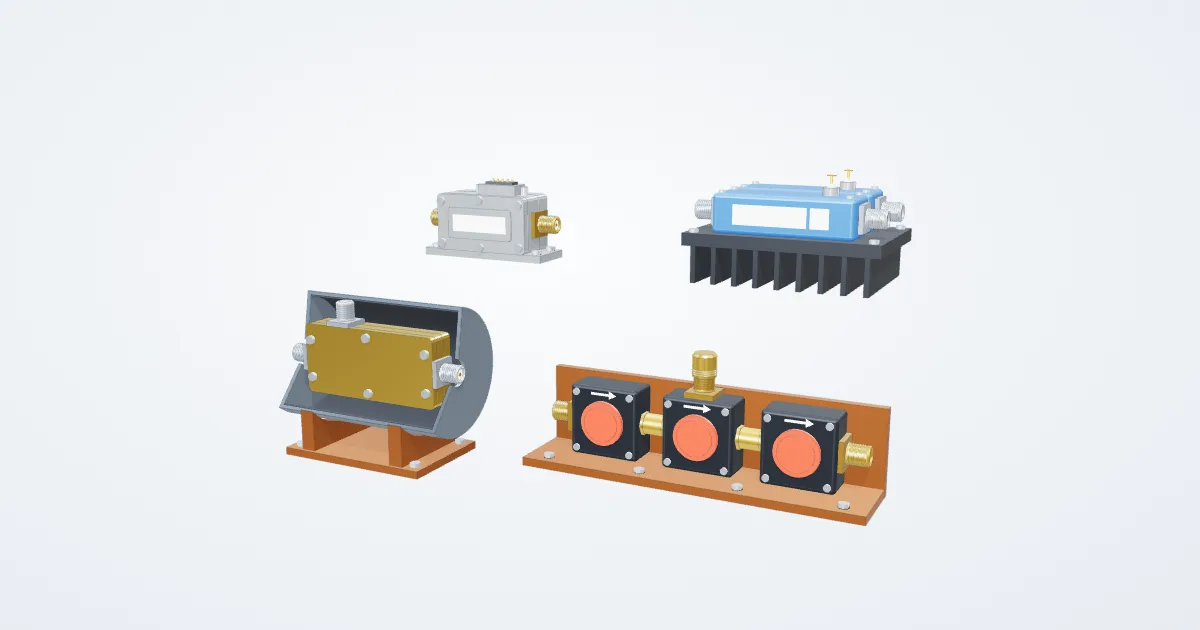
What to look for: The parametric amplifier package and its pump line, the magnet-loaded circulator and isolator blocks, the HEMT amplifier module with its bias connector, and the small room-temperature amplifiers.
Compare the right roles
Why does a qubit readout chain need three amplifiers?
The readout pulse leaves the chip at around −130 to −120 dBm, so the noise added by the first amplifier largely sets how quickly and accurately a qubit can be measured. A parametric amplifier at the mixing chamber adds close to the minimum noise physics allows, a HEMT amplifier at 4 K then adds about 40 dB of gain with a few kelvin of noise, and room-temperature amplifiers bring the signal up to a level the digitizers can read. Each stage makes the next one’s noise matter less.
Do listed companies make the parametric amplifiers?
Few. QuantumCTek, a listed Chinese quantum company, lists a Josephson impedance-tapered parametric amplifier among the cryogenic components it configures for customers. Otherwise commercial traveling-wave parametric amplifiers come from private firms such as Silent Waves, QuantWare, SCALINQ and VASTA, Bluefors packages one in its readout module, and many qubit groups build their own. Raytheon BBN, part of RTX, developed a 5–7 GHz Josephson parametric amplifier sold through Quantum Microwave, but it has been listed as out of stock since at least March 2025, so RTX is not mapped.
Amphenol, through Narda-MITEQ, and AmpliTech sell cryogenic low-noise amplifiers marketed for quantum computing, Japan’s 2025 supply-chain roadmap calls Narda-MITEQ room-temperature amplifiers relatively popular for qubit readout, and QuantumCTek lists a Josephson parametric amplifier among its cryogenic components. Most of the chain comes from private specialists: Low Noise Factory’s HEMT amplifiers hold a high share in superconducting-qubit research, QuinStar and LNF supply most cryogenic circulators and isolators, and traveling-wave parametric amplifiers come from startups such as Silent Waves, QuantWare and SCALINQ or inside Bluefors’ readout module.
Open each company below for its source and limitations. Sector membership does not establish a confirmed supply contract.
Inside the assembly
Parametric amplifier
A traveling-wave or Josephson parametric amplifier that boosts the few-photon readout signal while adding close to the minimum noise quantum mechanics allows.
Stock-link scope: Near-quantum-limited Josephson or traveling-wave parametric amplifiers at the mixing chamber. QuantumCTek is the only listed company we found offering one: a Josephson impedance-tapered parametric amplifier among the cryogenic components it configures for customers. Commercial TWPAs otherwise come from private firms (Silent Waves, QuantWare, SCALINQ and VASTA), Bluefors sells a readout module with a TWPA, and many qubit groups build their own. Raytheon BBN (RTX) developed a 5–7 GHz JPA sold through Quantum Microwave, but it was listed as out of stock in March 2025 and still is, so RTX is not mapped.
Also in this part (not publicly listed): Silent Waves Not publicly listed, QuantWare Not publicly listed, SCALINQ Not publicly listed, VASTA Not publicly listed, Bluefors Not publicly listed, Quantum Microwave Not publicly listed
Circulators & isolators
Ferrite devices that let the readout signal travel one way, up toward the amplifiers, while noise and back-action coming down are absorbed in cold loads.
Stock-link scope: Cryogenic ferrite circulators and isolators pass the readout signal up and block amplifier noise going down. No listed maker is verified for this role: the AIST roadmap says QuinStar (US) and Low Noise Factory (Sweden) products are the most used and that Nihon Tsushinki sells isolators rated to 4 K, and ETH Zurich’s setup uses a QuinStar circulator plus two isolators; all three are private. TDK, Murata and Teledyne showed no cryogenic quantum isolator in our sources, and Smiths Interconnect’s isolator business now belongs to privately held Molex.
No verified direct company match in the current universe.
Also in this part (not publicly listed): QuinStar Technology Not publicly listed, Low Noise Factory Not publicly listed, Nihon Tsushinki Not publicly listed
HEMT amplifier
A low-noise amplifier built from high-electron-mobility transistors and anchored at 4 kelvin, where cooling keeps its added noise low.
Stock-link scope: Cryogenic HEMT low-noise amplifiers on the 4 K plate. AmpliTech sells HEMT amplifiers it markets for quantum computers (a 6–8.5 GHz model with 42 dB gain, 2 K noise and 4 mW, per the AIST roadmap), and Amphenol’s Narda-MITEQ sells CLNA cryogenic amplifiers qualified to 4 K and marketed for quantum computing. Private Low Noise Factory holds a high share in superconducting-qubit research; Cosmic Microwave Technology (licensed Caltech designs) and Nihon Tsushinki (a 2026 NEDO project on integrated cryogenic amplifiers) are other private makers. No source tied Northrop Grumman’s InP HEMT process to these amplifiers.
Also in this part (not publicly listed): Low Noise Factory Not publicly listed, Cosmic Microwave Technology Not publicly listed, Nihon Tsushinki Not publicly listed, Narda-MITEQ Subsidiary of Amphenol (APH)
Room-temperature amplifiers
Low-noise amplifiers outside the refrigerator that raise the signal to the level the down-conversion and digitizing electronics need.
Stock-link scope: Low-noise amplifiers at room temperature that lift the readout signal before down-conversion; the parts are generic and many vendors qualify. The AIST roadmap names Narda-MITEQ (Amphenol) and private B&Z Technologies as relatively popular, and AmpliTech sells LNAs from 50 kHz to 44 GHz for markets including quantum computing. Mini-Circuits (private) is also common. Qorvo and MACOM sell general-purpose LNAs but showed no quantum-specific role, so they are not mapped.
Also in this part (not publicly listed): B&Z Technologies Not publicly listed, Mini-Circuits Not publicly listed, Narda-MITEQ Subsidiary of Amphenol (APH)