How this system works
The gas handling cabinet: turbomolecular and backing pumps that circulate the mixture and pump the vacuum can, the helium-3/helium-4 mixture and its storage tank, and the valves and gauges that run the cycle.
The turbomolecular pump draws helium-3 vapour off the still, the backing pump exhausts it, the mixture returns to the refrigerator or waits in its tank, and valves and gauges steer and watch every line.
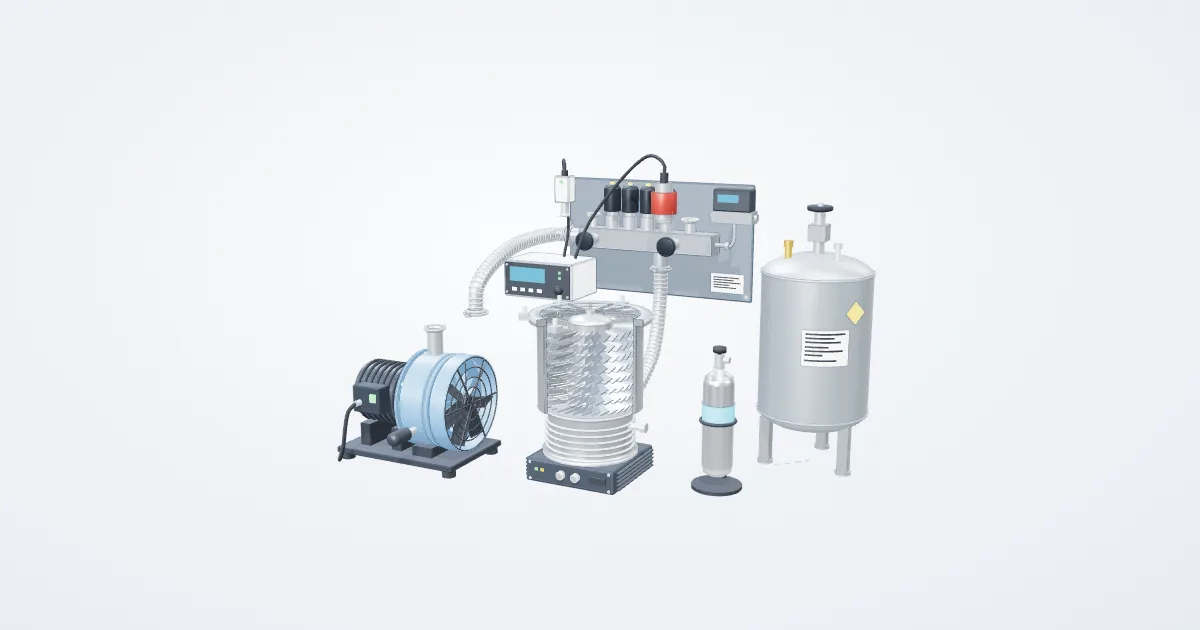
What to look for: The turbomolecular pump with its fan and controller, the scroll backing pump, the mixture storage tank, the valve block with its actuators, and the gauge heads and controller display.
Compare the right roles
Where does the helium-3 in a dilution refrigerator come from?
Almost all of it comes from decaying tritium. The U.S. DOE Isotope Program sells helium-3 separated during tritium processing at the Savannah River Site; Laurentis Energy Partners, part of Ontario Power Generation, extracts it from tritium stored at the Darlington nuclear station and Air Liquide distributes it; Russian government stocks were historically the other main source. Interlune estimates U.S. output at about 1 kilogram a year and cites a price of $20 million per kilogram, while a 2011 Congressional Research Service report put historical U.S. auction prices at $40–85 per liter, with commercial prices reaching $2,000 per liter or more after the shortage.
Can helium-3 supply keep up with quantum computing?
Not quickly from tritium, which takes years to produce and then decays with a half-life of about 12 years; DOE says recycling and alternative technologies have cut projected federal demand to under 6,000 liters a year. Interlune says its Cold Capture process made 99% pure helium-3 from Grade A helium (July 2026) and could yield up to 2.5 kilograms a year across U.S. helium plants, and it has signed agreements with Bluefors (up to 10,000 liters a year, 2028–2037), Maybell (2029–2035) and the DOE (3 liters of lunar helium-3 by April 2029). These are plans and contracts, not deliveries.
A 2016 Bluefors manual names Pfeiffer Vacuum turbopumps and a gauge controller, Edwards (Atlas Copco) and Agilent scroll pumps, and a valve block co-developed with VAT Group, which says it supplies valves for dilution refrigerators; INFICON and MKS sell gauges to research labs. Air Liquide distributes helium-3 from Ontario’s Laurentis under a long-term agreement, Linde and Merck KGaA’s Sigma-Aldrich also sell it, and private Interlune has signed purchase agreements with Bluefors and Maybell for helium-3 it plans to deliver from 2028.
Open each company below for its source and limitations. Sector membership does not establish a confirmed supply contract.
Inside the assembly
Turbomolecular pumps
High-speed turbine pumps that draw helium-3 vapour from the still and evacuate the vacuum can to a high vacuum.
Stock-link scope: Turbomolecular pumps on the still line draw helium-3 vapor out of the dilution unit and hand it to the backing pumps, and a turbopump also evacuates the vacuum can. Bluefors’ 2016 BF-LD manual lists one or two Pfeiffer HiPace 400 turbopumps for dilution circulation and an optional Agilent V301 service turbopump; Leybold (Atlas Copco) markets TURBOVAC turbopumps for dilution refrigerators without a named customer. Bluefors’ current Service Booster is a dedicated turbopump whose maker is not named, and other refrigerator makers do not disclose theirs. Shimadzu and Ebara make turbopumps, but no dilution-refrigerator source was found, so they are not mapped.
Also in this part (not publicly listed): Bluefors Not publicly listed, Busch Group Not publicly listed
Backing pumps
Oil-free scroll or multistage roots pumps that exhaust the turbomolecular pumps and push the circulating gas back toward the refrigerator.
Stock-link scope: Oil-free backing pumps behind the turbos compress the returning mixture and rough out the system. Bluefors’ 2016 manual lists Edwards (Atlas Copco) XDS35i or nXDS15i scroll pumps for dilution circulation, an Agilent SH-110 scroll for service roughing and an Agilent IDP-3 scroll used as the helium compressor. Its Gen 2 system (2024) replaced the scroll pump with a multistage roots pump rated for six maintenance-free years and does not name the maker; Leybold (Atlas Copco) markets ECODRY plus multistage roots pumps and Pfeiffer its HiScroll range for such uses. Anest Iwata, a pioneer of dry scroll pumps, has no dilution-refrigerator source and is not mapped.
Also in this part (not publicly listed): Bluefors Not publicly listed, Busch Group Not publicly listed
Helium-3 mixture
The helium-3/helium-4 mixture that the dilution unit runs on, and the tank that stores it when the refrigerator is warm. Helium-3 is a rare isotope made mainly by tritium decay.
Stock-link scope: Helium-3 comes almost entirely from decaying tritium. The U.S. DOE Isotope Program sells helium-3 separated during tritium processing at the Savannah River Site, Ontario Power Generation’s Laurentis Energy Partners has extracted it from tritium stored at the Darlington CANDU station since 2021, and Russian government stocks were historically the other main source. Air Liquide distributes Laurentis’s helium-3 under a long-term agreement and sells it at over 99.9% isotopic purity for dilution refrigerators, Linde offers helium-3 among its isotopes, and Merck KGaA’s Sigma-Aldrich lists it in its catalog. Private Interlune has signed agreements to supply Bluefors, Maybell and the DOE from 2028 with helium-3 it plans to recover from the Moon and, with its Cold Capture process, from terrestrial helium. Cambridge Isotope Laboratories (Otsuka) lists no helium-3, and BWXT’s Kinectrics built an extraction skid but does not sell the gas.
Also in this part (not publicly listed): Interlune Not publicly listed, Laurentis Energy Partners Subsidiary of Ontario Power Generation
Valves & fittings
Pneumatic and manual vacuum valves, bellows lines, clamps and fittings that route the mixture through its cold traps, pumps and tank.
Stock-link scope: Pneumatic valves, a gate valve, a needle valve and back-pressure valves route the mixture between the still, the pumps, the cold trap and the storage tank. Bluefors’ 2016 manual integrates most tubes and vacuum valves in an aluminum block custom-developed with VAT, with standard VAT actuators, and VAT says it supplies vacuum and gas-dosing valves for dilution refrigerators. Bluefors has standardized on Swagelok tube fittings and high-pressure panels wherever pure helium runs at high pressure; Swagelok is private. MKS makes valves for vacuum processes without a documented quantum role, and Parker-Hannifin was checked and is not mapped.
Also in this part (not publicly listed): Swagelok Not publicly listed, Bluefors Not publicly listed
Gauges & controllers
Pressure gauges and flow meters on every line, read by the controller that sequences cooldowns and watches for leaks.
Stock-link scope: Pressure gauges on each line, a flow meter on the circulation path and a controller that switches valves and pumps run the gas handling system. Bluefors’ 2016 manual reads its gauges through a Pfeiffer MaxiGauge TPG 256 six-channel controller and switches valves and reads the flow meter through a National Instruments USB-6008 data-acquisition device; National Instruments is now part of Emerson. Its Gen 2 system (2024) moved to a PLC with EtherCAT and ‘latest generation’ gauges whose makers are not named. INFICON and MKS sell vacuum gauges and controllers to research labs without a documented dilution-refrigerator role.
Also in this part (not publicly listed): Bluefors Not publicly listed, Busch Group Not publicly listed