| Constraint | Why it binds | A documented figure | Listed companies connected | Private or inside a group |
|---|---|---|---|---|
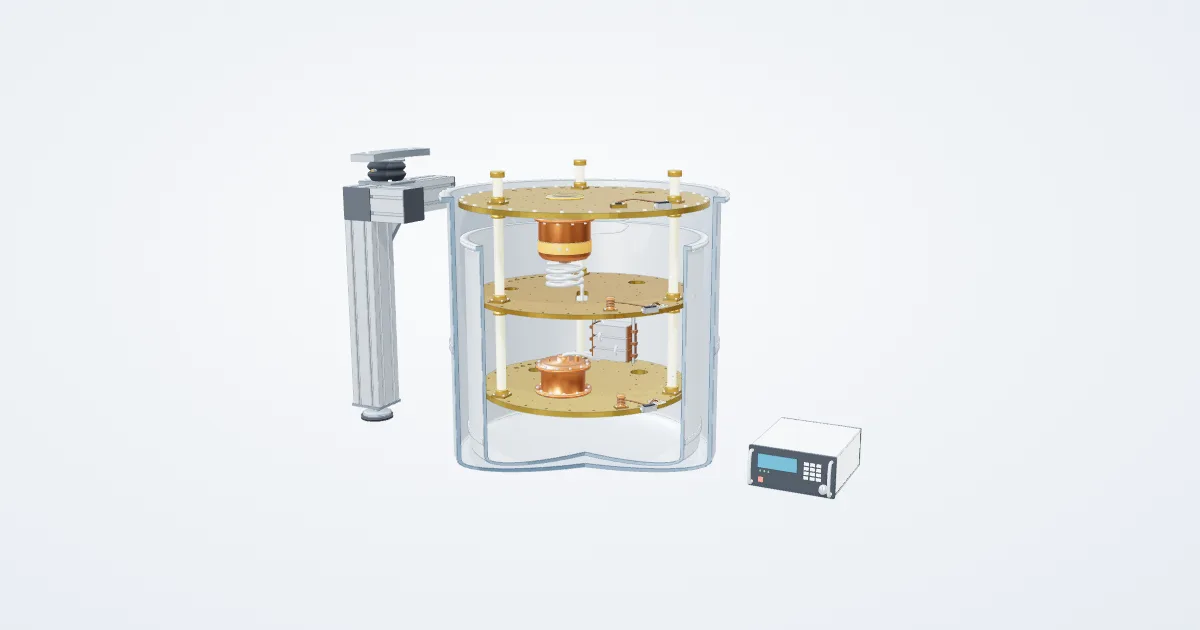
| Dilution refrigerators | Every superconducting machine needs one, from a few specialist makers | Well over 1,700 systems delivered by Bluefors in total | ULVAC, QuantumCTek, FormFactor, Nippon Sanso, Air Liquide | Bluefors, Quantum Design Oxford, Maybell (private) |
| Helium-3 | Made by tritium decay, so output grows slowly | 40,000 liters of world output in 2025 (USGS estimate) | Air Liquide, Linde, Merck KGaA | Laurentis (Ontario Power Generation), Interlune (private) |
| Helium-4 | The cryocooler’s working gas, produced in few countries | About 190 million m³ of world output in 2025 (USGS estimate) | ExxonMobil, Linde, Air Products, Iwatani, Nippon Sanso | — |
| Lines per qubit | Each line adds heat and takes space on the cold plates | 124 RF lines for 50 qubits used one refrigerator’s full capacity (ETH Zurich) | Huber+Suhner, Amphenol, JAE, Hirose, QuantumCTek | Bluefors, Delft Circuits, COAX, TOTOKU (private) |
| Readout parts | Specialist amplifiers and isolators, mostly from private firms | 250 HEMTs to read 1,000 qubits four per line (AIST roadmap) | Amphenol, AmpliTech, QuantumCTek | Low Noise Factory, QuinStar, Silent Waves (private) |
How many quantum computers are built today
Volumes are small. The Quantum Insider, a trade publisher, counted 41 quantum computers sold worldwide in 2024 and put superconducting systems at about 40% of orders by count, which stock3d uses to set the Scale mode’s default of 16 superconducting systems a year. IQM, which sells machines for customers’ own sites, says it has sold 26 systems and delivered 17 since 2018, and IBM says it has deployed more than 90.
The Scale mode of the interactive 3D model asks what happens as that number grows. It compares each part’s need per machine with today’s output of the whole category, turning a part amber as demand nears capacity and red when it is well over; parts without a published output stay grey. Makers name the same pressure points: IQM’s prospectus lists dilution refrigerators and helium gas products, low-noise microwave components, CPUs, GPUs, FPGAs and silicon wafers among the supplies it depends on.
Reference: The Quantum Insider: quantum industry sees big bets and bigger deals in early 2025 (June 7, 2025).
Dilution refrigerators: few makers, long lead times
No refrigerator maker publishes annual output. Bluefors, which is private and calls itself the market leader, installed its 1,000th system in November 2022 and now cites well over 1,700, roughly 200 a year by stock3d’s estimate. ICV, a market-research firm, estimated in 2025 that Bluefors and Oxford Instruments, whose business is now Quantum Design Oxford, held more than 70% of the market; the listed makers, ULVAC, QuantumCTek, FormFactor, Nippon Sanso and Air Liquide’s Cryoconcept, share the rest with private firms such as Maybell and Leiden Cryogenics.
Lead times depend on size. Bluefors says preconfigured systems for 5-qubit-scale work reach installation four months after order, while PostQuantum, a trade publication, lists 6–12 months for a large XLD1000sl, and Bluefors says a 2024 expansion in Syracuse, New York, increased capacity by almost 45%. In the Scale mode the refrigerator is the first part to tighten, amber from about 120 new systems a year and red above about 300; that figure counts one maker’s output, so the ceiling for the whole category is higher.
Reference: Bluefors: company story.
Helium-3: an isotope made by decay
Helium-3 comes from decaying tritium. DOE separates it at the Savannah River Site and makes thousands of liters available each year, Ontario Power Generation’s Laurentis extracts it at the Darlington station and distributes it through Air Liquide, and the USGS estimates world output at 40,000 liters in 2024 and 2025. Interlune, as reported by The Quantum Insider, says each refrigerator uses a few dozen liters, and PostQuantum cites about 40 liters for a large Bluefors XLD1000sl.
Output cannot jump: tritium decays into helium-3 only gradually, and DOE says demand reached as high as 70,000 liters a year in 2008 before recycling and alternative technologies cut federal needs. Interlune plans lunar and terrestrial supply and has agreements with Bluefors for up to 10,000 liters a year from 2028 and with Maybell from 2029; these are plans, not deliveries. At about 40 liters per new large refrigerator, the Scale mode turns helium-3 amber at about 600 new systems a year and red above about 1,500.
Reference: DOE Isotope Program: supply and demand of helium-3.
Helium-4: a gas from few places
Dry refrigerators no longer boil off liquid helium, but their compressors and cold heads run on helium-4, and the USGS notes that nothing substitutes for helium in cryogenic applications below −429 °F. World output was about 190 million cubic meters in 2025, with the United States at about 81 million and Qatar at about 63 million, and EU and US bans on Russian helium continued into 2025.
Prices respond quickly: Nippon Sanso raised Japanese helium prices by an average of 30% or more from July 2026 after production suspensions in the Middle East. ExxonMobil, Linde, Air Products, Air Liquide, Iwatani and Nippon Sanso supply helium, none of them naming a quantum customer. In the Scale mode helium-4 stays within capacity even at 10,000 systems a year; the exposure is concentration, not volume.
Reference: USGS: Mineral Commodity Summaries 2026, helium and rare gases.
Wiring: lines, heat and space
Every qubit needs its own control lines, and every line carries heat into the cold stages. ETH Zurich’s 50-qubit design needed 124 RF lines and used its refrigerator at full capacity; its heat budget would have allowed 150 qubits with three times the line capacity, and the authors expect future large refrigerators to need several dilution units. Bluefors’ own research, published in September 2026, derives a minimum line pitch, and so a maximum number of connections, from qubit fidelity requirements.
Suppliers are responding on several fronts: denser coax such as Bluefors’ wiring of up to 1,008 lines and Huber+Suhner’s 192-channel multicoax, flex ribbons from private Delft Circuits and Maybell, and control moved closer to the chip. D-Wave says its superconducting control circuitry lets many tens of thousands of devices be controlled and read with only hundreds of wires, and that it demonstrated on-chip control of gate-model qubits in January 2026; SEEQC, which has filed for an IPO, builds superconducting control and readout chips.
Readout parts: specialists and a gap
Each output line needs isolators, a parametric amplifier and a HEMT amplifier, and the counts rise with qubits: Japan’s 2025 roadmap estimates that reading 1,000 qubits four per line would take 250 HEMT amplifiers drawing about 2 to 4.4 W at 4 K. PostQuantum, a trade publication, reports that lead times for new HEMTs can stretch to months and advises keeping spares.
Much of this chain is private. By the roadmap’s account, Low Noise Factory holds a high share of HEMT amplifiers in qubit research and its circulators and isolators, with QuinStar’s, are the most used, while traveling-wave amplifiers come from start-ups such as Silent Waves. Low Noise Factory says it is developing an InP HEMT process for larger-scale production, and Japan’s NEDO selected Nihon Tsushinki in July 2026 to develop domestic cryogenic amplifiers. Listed exposure runs through Amphenol’s Narda-MITEQ, AmpliTech and QuantumCTek, and no listed maker of cryogenic isolators was verified.
What to check before connecting a company
A bottleneck is not a revenue forecast. A tight part can still be a small business for a listed supplier: helium-3 is a catalog line at Air Liquide, Linde and Merck KGaA, and XMA had about $15 million of annual sales when Amphenol bought it. Where the constraint sits with a private company, such as Bluefors or Low Noise Factory, no listed share gives direct exposure, and stock3d never substitutes a listed partner, customer or investor for it.
Watch for changes that move the constraint: modular refrigerators such as the unit ULVAC is developing to IBM’s specifications, the turbo-cooled system IHI and Nippon Sanso are developing, helium-3-free coolers, flex wiring and on-chip control. The Scale mode is a teaching model with sourced inputs, not a forecast of any company’s sales; open the refrigerator, helium and wiring parts in the interactive 3D model to see the evidence behind each connection.