How this system works
A dry dilution refrigerator: five gold-plated copper stages from about 50 kelvin to about 10 millikelvin, the dilution unit that provides the last step of cooling, thermometers and heaters on every stage, and the nested vacuum can and radiation shields, hung from a vibration-isolated frame.
Each stage is colder than the one above it. The dilution unit does the final cooling at the mixing chamber, the plates and their supports hold the stages apart, the cans stop heat from shining in, the thermometers watch every stage, and the frame keeps it all still.
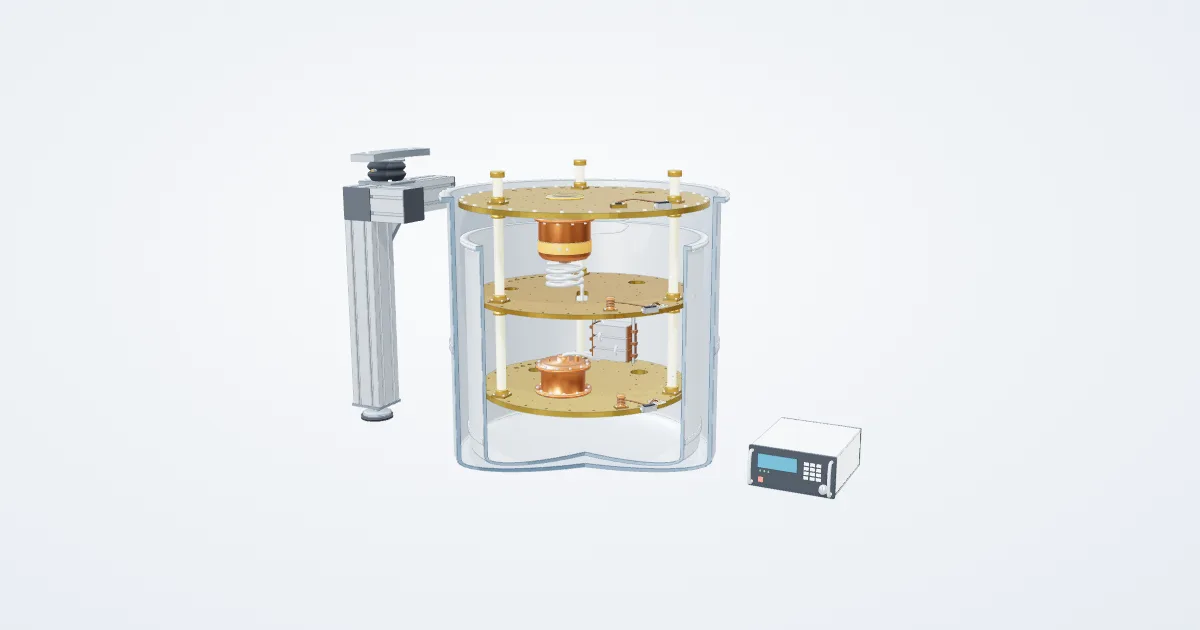
What to look for: The still pot, the heat-exchanger helix and the copper mixing chamber among the lower plates, the gold plates and their thin supports, the cut edges of the nested shields, the sensors on the plates with their temperature controller, and a frame post with its vibration isolator.
Compare the right roles
Who makes the dilution refrigerators in superconducting quantum computers?
Many come from private specialists: Bluefors of Finland, which calls itself the world leader in cryogenic cooling systems for quantum technology and has owned pulse-tube maker Cryomech since 2023, plus Quantum Design Oxford, Maybell, Leiden Cryogenics and Zero Point Cryogenics. Listed makers include ULVAC (the University of Osaka’s all-Japanese machine since July 2025, and a next-generation model developed with IBM’s input for 2026), QuantumCTek (ez-Q Fridge, up to the thousand-qubit class), FormFactor (the HPD Flatiron benchtop refrigerator), Nippon Sanso (e-Dilution) and Air Liquide, which owns 80% of Cryoconcept.
Is Oxford Instruments still a dilution-refrigerator company?
No. Oxford Instruments agreed on June 10, 2025 to sell its NanoScience business, maker of the Proteox dilution refrigerators, to privately held Quantum Design for £60m, and Quantum Design completed the deal on Jan 2, 2026; the business now trades as Quantum Design Oxford. Oxford Instruments reported £42.4m of NanoScience proceeds in its FY2026 results and still sells plasma etch and deposition tools used to make qubits, so it appears under the processor sector instead.
FormFactor (HPD Flatiron), ULVAC (whose refrigerator cools the University of Osaka’s all-Japanese quantum computer and which is developing a model to IBM’s specifications), Nippon Sanso (e-Dilution) and QuantumCTek (ez-Q Fridge) make dilution refrigerators, Air Liquide owns 80% of French maker Cryoconcept, and Rigetti’s collaboration lets Quanta Computer develop refrigerators for it. Mitsubishi Materials supplies cryogenic-grade copper upstream. Bluefors, Quantum Design (which acquired Oxford Instruments’ NanoScience in January 2026), Maybell, Leiden Cryogenics and Zero Point Cryogenics are private.
Open each company below for its source and limitations. Sector membership does not establish a confirmed supply contract.
Inside the assembly
Mixing chamber & still
The dilution unit. In the mixing chamber, helium-3 crossing from a concentrated into a dilute phase absorbs heat; the still above evaporates it off, and heat exchangers of sintered silver precool the returning stream.
Stock-link scope: The dilution unit is built by the refrigerator maker. ULVAC’s dilution refrigerator cools the University of Osaka’s all-Japanese superconducting quantum computer (running since July 28, 2025), and ULVAC is developing a 10 mK-class model to IBM’s specifications for launch in 2026; QuantumCTek’s ez-Q Fridge F500–F1500 are designed for 100- to 1,000-qubit superconducting machines; FormFactor sells the HPD Flatiron benchtop dilution refrigerator (30 mK); Nippon Sanso has sold e-Dilution refrigerators since 2003 and is developing a larger dilution stage under NEDO; Air Liquide acquired 80% of French maker Cryoconcept in 2020 (current range not verified); and Rigetti’s 10-K says Quanta Computer may develop dilution refrigerators for it under a 2025 collaboration. Private makers include Bluefors, Quantum Design Oxford (the former Oxford Instruments NanoScience), Maybell, Leiden Cryogenics, Zero Point Cryogenics and ICEoxford. Quanta is not mapped here: the collaboration allows statements of work, and Rigetti discloses no delivered refrigerator.
Also in this part (not publicly listed): Bluefors Not publicly listed, Quantum Design (Quantum Design Oxford) Not publicly listed, Maybell Quantum Not publicly listed, Leiden Cryogenics Not publicly listed, Zero Point Cryogenics Not publicly listed, ICEoxford Not publicly listed, ULVAC CRYOGENICS Subsidiary of ULVAC (6728.T) and Edwards (Atlas Copco) as a 50:50 joint venture, Cryoconcept Subsidiary of Air Liquide (AI.PA)
Temperature stages
Gold-plated copper plates at about 50 kelvin, 4 kelvin, 0.8 kelvin (the still), 0.1 kelvin (the cold plate) and 10 millikelvin (the mixing chamber), held apart by thin supports that conduct little heat.
Stock-link scope: The copper stages come with each dilution refrigerator, so the listed refrigerator makers (ULVAC, QuantumCTek, FormFactor, Nippon Sanso) are mapped; stage sizes are published only for some systems, such as the 590 mm sample space of QuantumCTek’s F1100 and the 530 mm plate of private Quantum Design Oxford’s ProteoxLX. Mitsubishi Materials is mapped upstream because it says its high-purity copper (residual resistivity ratio above 3,000) is used in cryogenic-refrigerator components. No source names the copper or gold-plating supplier of any quantum cryostat, and Aurubis (Cu-OFE copper with no cryogenic use cited) is not mapped.
Also in this part (not publicly listed): Bluefors Not publicly listed, Quantum Design (Quantum Design Oxford) Not publicly listed, Maybell Quantum Not publicly listed
Vacuum can & shields
The outer vacuum can that seals the insert, and the radiation shields nested inside it, each bolted to its own stage, that stop warmer surfaces from shining heat onto colder ones.
Stock-link scope: The outer vacuum can and radiation shields are part of each maker’s cryostat, and no listed company documents cans or shields as a separate product for quantum cryostats, so only the listed dilution-refrigerator makers are mapped. Bluefors (private) sells additional radiation shields and magnetic shielding as options; the magnetic shields around the chip belong to the processor sector.
Also in this part (not publicly listed): Bluefors Not publicly listed, Quantum Design (Quantum Design Oxford) Not publicly listed
Thermometers & heaters
Resistance thermometers and heaters on every stage, read by a temperature controller that regulates the still and mixing chamber and reports the refrigerator’s health.
Stock-link scope: QuantumCTek makes the RX1000 ruthenium-oxide thermometer for dilution refrigerators (7–600 mK working range, calibrated against a noise thermometer below 200 mK) and the TC16 controller (16 measurement channels, 5 heater outputs). The main Western suppliers are private: Lake Shore Cryotronics (Cernox and Rox sensors, AC resistance bridges and temperature controllers; now a DwyerOmega brand) and the refrigerator makers themselves, such as Quantum Design Oxford, whose ProteoxLX specifies temperature control from 7 mK to 30 K. No other listed thermometry supplier was verified.
Also in this part (not publicly listed): Lake Shore Cryotronics Subsidiary of DwyerOmega (private), Bluefors Not publicly listed, Quantum Design (Quantum Design Oxford) Not publicly listed
Support frame & isolation
The rigid frame the refrigerator hangs from, with vibration isolation between it and the floor, so pumps, the cryocooler and the building do not shake the qubits.
Stock-link scope: QuantumCTek lists a vibration-damping system in its ultra-low-temperature platform alongside the dilution refrigerator. Frames usually come from the refrigerator maker: private Quantum Design Oxford gives the ProteoxLX a cross-braced stiffened frame that limits vibration without active damping, and Bluefors (private) offers additional vibration isolation. AMETEK’s TMC vibration-isolation tables are not mapped because TMC names no cryostat or quantum use.
Also in this part (not publicly listed): Bluefors Not publicly listed, Quantum Design (Quantum Design Oxford) Not publicly listed