How this system works
The input side of the signal chain: coaxial and flex lines running down through the stages, with attenuators and filters thermally anchored at each one, and hermetic connectors where the lines leave the vacuum.
Signals go in through hermetic connectors, down coaxial or flex lines that conduct little heat, and through attenuators and filters that strip noise and stray radiation at each stage before reaching the chip.
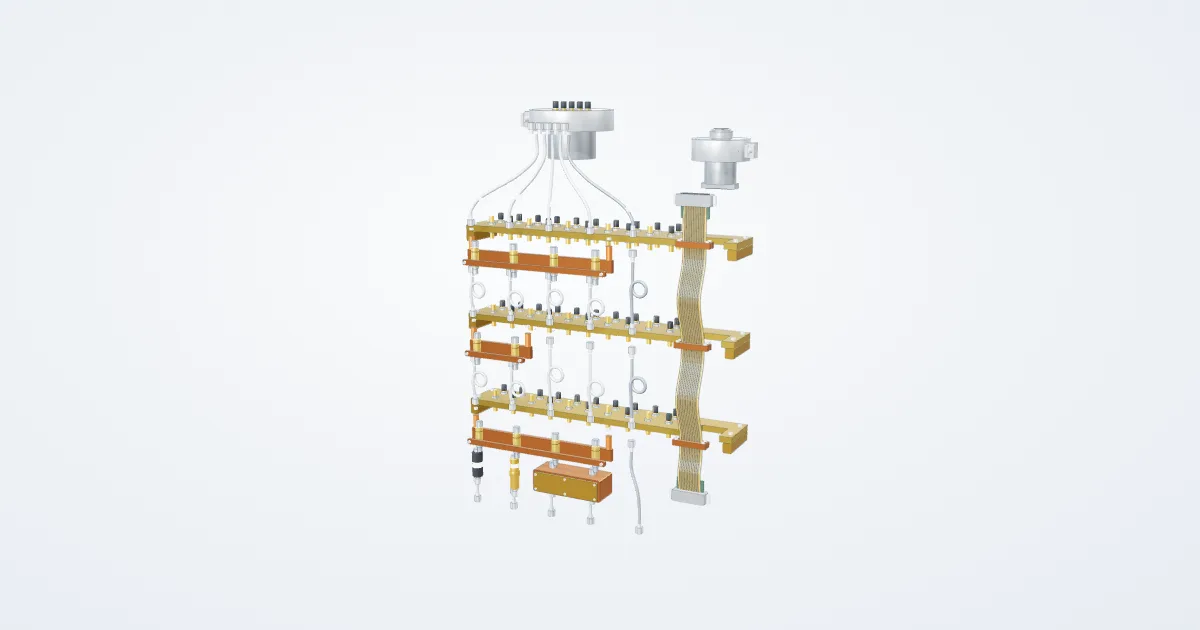
What to look for: The coaxial lines passing through the plates, the flat flex ribbon, the small attenuators clamped to each plate, the filter housings near the bottom, and the connector panel at the top.
Compare the right roles
Why does each input line need attenuators at several temperature stages?
Room-temperature electronics send thermal microwave noise down every line along with the control pulses. An attenuator anchored at a stage absorbs most of that noise and adds only the much smaller noise of its own temperature, so stacking them at 4 K, the cold plate and the mixing chamber leaves the chip with noise set by the coldest stage; ETH Zurich’s 100-qubit-scale design uses about 60 dB in total to cut the thermal photon number to about one in a thousand. Output lines cannot be attenuated, because the readout signal is too weak, so they use isolators and circulators instead.
Why are flex cables replacing some coax lines?
Every semi-rigid coax line conducts heat into the colder stages and takes space on crowded plates, which limits how many qubits one refrigerator can serve. Flex ribbons put many lines on one thin polyimide sheet: Delft Circuits’ Cri/oFlex carries eight channels per 0.3 mm flex with superconducting NbTi traces and built-in attenuators and filters, and Bluefors offers it at up to 256 lines per side-loading port. High-density coax harnesses from Bluefors and Huber+Suhner are the other route; the specialist flex makers are private.
Huber+Suhner sells NbTi, CuNi and stainless semi-rigid lines and a 192-channel multicoax system and is developing interconnects with Bluefors, and QuantumCTek sells complete cryogenic cable assemblies. Amphenol’s XMA makes cryogenic attenuators and IR filters that Japan’s 2025 supply-chain roadmap ranks among the most used, the same roadmap calls JAE’s non-magnetic SMPM connectors almost the only option and names TE and Bel Fuse’s Cinch for micro-D connectors, and Hirose (SER), Qnity (the Eccosorb absorber) and QTREX (printed interconnects in development) have smaller roles. Flex ribbons and much of the coax come from private firms such as Delft Circuits, Bluefors, COAX and TOTOKU.
Open each company below for its source and limitations. Sector membership does not establish a confirmed supply contract.
Inside the assembly
Coaxial lines
Semi-rigid coaxial cables of stainless steel, copper-nickel or superconducting niobium-titanium, chosen stage by stage to carry microwave signals while conducting little heat.
Stock-link scope: Semi-rigid coax (stainless steel, CuNi, CuBe or superconducting NbTi, often 0.86 mm) carries drive, flux and readout signals between stages. Huber+Suhner is mapped for its quantum-computing semi-rigid range, with NbTi lines under 0.5 dB/m at 4 K and 10 GHz; QuantumCTek sells cryogenic cable assemblies in CuNi, stainless, aluminum and NbTi specified stage by stage; QTREX’s printed coaxial interconnect is still pre-commercial. Much of the market is private: COAX Co. (Japan), TOTOKU (Japan, Carlyle-owned since its 2023 delisting), CryoCoax (an Intelliconnect division), Radiall and Bluefors, which wires its own refrigerators. Furukawa sold its 57% TOTOKU stake in 2022, and Fujikura and Furukawa showed no current quantum coax role in the sources checked.
Also in this part (not publicly listed): COAX CO., LTD. Not publicly listed, TOTOKU Subsidiary of TTC Holdings (Carlyle-managed fund), CryoCoax (Intelliconnect) Subsidiary of Intelliconnect (Trexon group, not listed), Radiall Not publicly listed, Bluefors Not publicly listed
Flex cables
Flexible ribbons carrying dozens of microwave or DC lines side by side on a thin film, a denser alternative to individual coaxial cables.
Stock-link scope: High-density wiring that carries many lines per cable or ribbon. Printed flex ribbons come from private firms: Delft Circuits’ Cri/oFlex (eight NbTi or silver striplines per 0.3 mm flex with built-in attenuators and filters, sold with Bluefors) and Maybell’s LF CryoTrace, based on an MIT Lincoln Laboratory design it licensed (MIT News, June 2026). Huber+Suhner is mapped for its MXP multicoax system (192 flexible or semi-rigid coax channels on an ISO 100 flange, running to the mixing chamber), Hirose for its SER unit’s NbTi multi-channel coax connector cables and QTREX for printed high-density interconnects in development; these are coax harnesses rather than printed ribbons. Bluefors’ High-Density Wiring (up to 168 lines per port) is private. Rigetti’s 10-K says Quanta Computer may develop flexible cables under a 2025 collaboration, a possibility rather than a disclosed product, so Quanta is not mapped here.
Also in this part (not publicly listed): Delft Circuits Not publicly listed, Maybell Quantum Not publicly listed, Bluefors Not publicly listed, CryoCoax (Intelliconnect) Subsidiary of Intelliconnect (Trexon group, not listed), Hirose SER Subsidiary of Hirose Electric (6806.T)
Attenuators
Small cryogenic attenuators bolted to the plates on every input line. Each absorbs most of the signal together with the thermal noise from warmer stages above.
Stock-link scope: Attenuators anchored at 4 K, the cold plate and the mixing chamber strip thermal noise from input lines. Amphenol is mapped through XMA, which sells cryogenic attenuators (including bulkhead types), terminations and DC blocks for quantum computing and which Japan’s 2025 AIST–RIKEN–Fujitsu–NEC roadmap names among the most used cryogenic SMA attenuators; Huber+Suhner sells 0–20 dB cryogenic attenuator blocks and ganged attenuators in its multicoax system; QuantumCTek sells cryogenic attenuators with its cable assemblies. Private alternatives include API Technologies, Radiall, Quantum Microwave, CryoCoax and Delft Circuits (attenuators on the flex). Smiths Interconnect, now owned by Molex, makes RF attenuators, but no cryogenic quantum line was found.
Also in this part (not publicly listed): API Technologies Not publicly listed, Radiall Not publicly listed, Quantum Microwave Not publicly listed, Delft Circuits Not publicly listed, CryoCoax (Intelliconnect) Subsidiary of Intelliconnect (Trexon group, not listed), XMA Corporation Subsidiary of Amphenol (APH)
Filters & IR absorbers
Low-pass and band-pass filters and infrared-absorbing filters that block stray high-frequency radiation, which would otherwise break the qubits’ superconducting pairs.
Stock-link scope: Low-pass, band-pass and infrared filters keep stray radiation and out-of-band noise off the qubits. Amphenol’s XMA sells cryogenic IR filters (the AIST roadmap says IR filters, once home-made by researchers, are now sold as products by XMA Amphenol and Kawashima Seisakusho), Huber+Suhner builds IR filters into its multicoax system, and QuantumCTek sells cryogenic filters with its cable assemblies. Qnity is mapped as an upstream material supplier: its Laird Eccosorb absorbers are cast into IR filters, as in ETH Zurich’s Eccosorb CR-124 filter. Conventional low- and high-pass filters come mostly from private Mini-Circuits and RLC Electronics; the roadmap also lists a ‘K&L’ filter maker, which we did not tie to Dover. Bluefors, Quantum Microwave and Delft Circuits sell private IR-filter products.
Also in this part (not publicly listed): Bluefors Not publicly listed, Mini-Circuits Not publicly listed, RLC Electronics Not publicly listed, Quantum Microwave Not publicly listed, Delft Circuits Not publicly listed, XMA Corporation Subsidiary of Amphenol (APH)
Connectors & feedthroughs
Miniature coaxial connectors at every stage and hermetic feedthroughs in the top plate that carry the lines out of the vacuum without leaking.
Stock-link scope: SMA connectors dominate between stages, smaller non-magnetic SMP or SMPM connectors sit near the chip, and hermetic feedthroughs seal the vacuum can. Huber+Suhner sells non-magnetic SMA connectors, hermetic bulkhead adapters and multicoax connectors for quantum computing; the AIST roadmap says JAE’s non-magnetic SMPM connectors are almost the only option at that size; QuantumCTek sells vacuum-hermetic adapters; Hirose’s SER unit sells NbTi multi-coax connectors for quantum computers; and TE and Bel Fuse’s Cinch are named as makers of micro-D connectors used for dense DC wiring, a generic role. Private suppliers include Rosenberger (non-magnetic SMP, widely used in Japanese labs), Fischer (hermetic DC connectors), Radiall and CryoCoax.
Also in this part (not publicly listed): Rosenberger Not publicly listed, Fischer Connectors Not publicly listed, Radiall Not publicly listed, CryoCoax (Intelliconnect) Subsidiary of Intelliconnect (Trexon group, not listed), Hirose SER Subsidiary of Hirose Electric (6806.T)