Fans still move air through power shelves, switch trays and any parts not on cold plates, and a rear-door heat exchanger can catch the warm exhaust in a water coil; temperature sensors and fan controllers set the airflow. In the Schneider Electric–AMD Helios reference design, liquid removes 84% of the rack’s heat and air handles the remaining 16% (Motivair, July 2026).
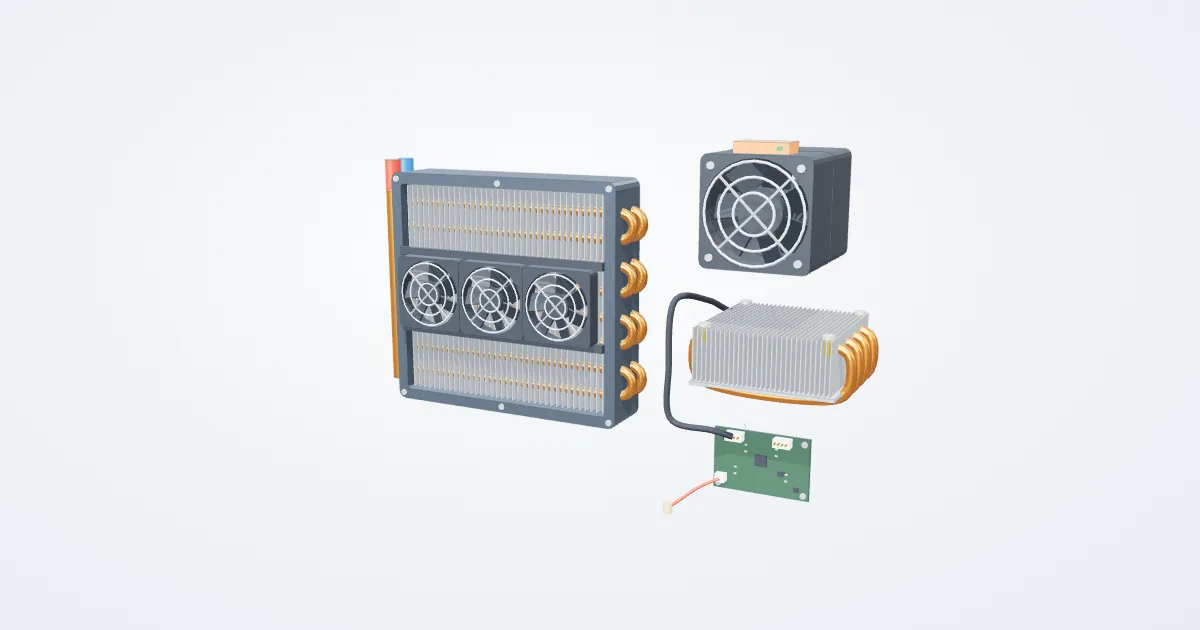
The air-cooled share of the heat: a fan module, an air heat sink, a section of a rear-door heat exchanger and the sensors that set fan speed.
Fans pull air front to back over heat sinks on the parts without cold plates. Sensors set the fan speed, and the rear-door coil captures the exhaust heat into liquid.
Illustrative fans and airflow example. Designs differ by manufacturer; the model is not a bill of materials.
What to look for: The fan’s rotor and guard, the fins and heat pipes of the heat sink, the coil and fins of the rear door, and the small sensors at each zone.
Cold plates cover the GPUs and CPUs, but power shelves, switch trays, network cards, drives and voltage regulators still shed heat into air. In the Schneider Electric–AMD Helios reference design, liquid removes 84% of the rack’s heat and air the other 16%, helped by rear-door heat exchangers. That is why fan makers such as SUNON and Delta sell into both air- and liquid-cooled AI servers.
Is a rear-door heat exchanger the same as direct-to-chip cooling?
No. A rear door is a water coil on the back of the rack that cools the hot exhaust air before it reaches the room; it never touches the chips. It complements direct-to-chip cooling by catching the air-cooled remainder. Published ratings in our sources range from 50 kW (Delta; Vertiv Liebert DCD) to 78 kW (nVent RDHX PRO).
SUNON, Delta, AVC, Sanyo Denki and Nidec make fans for AI servers, and SUNON puts AI servers at 22.6% of its 1Q26 sales. Schneider Electric (Motivair ChilledDoor), nVent, Vertiv, Delta and Kaori sell rear-door heat exchangers that capture the residual air heat.
Open each company below for its source and limitations. Sector membership does not establish a confirmed supply contract.
Inside the assembly
Fan modules
High-speed fans in power shelves, switch trays and other air-cooled parts that pull air front to back through the rack.
Stock-link scope: SUNON reports AI-server revenue at 22.6% of 1Q26 sales and sells server fans and AI fan walls; Delta’s 2025 annual report describes fans for air- and liquid-cooled AI servers and hot-swap rack fans; AVC makes server fans; Sanyo Denki developed a counter-rotating fan for generative-AI GPU servers; Nidec markets server and data-center fans. Which fan maker supplies a given NVL72 tray or power shelf is not disclosed, and private fan makers are not mapped.
Finned heat sinks and vapor chambers on network chips, power parts and other components that are not on cold plates.
Stock-link scope: Heat sinks, heat pipes and (3D) vapor chambers for servers: AVC, Delta (two-phase vapor-chamber heat sinks for AI GPU/ASIC chips and power racks), Auras (heat-pipe, vapor-chamber and 3D-VC modules), SUNON, Nidec and Forcecon (server thermal modules, catalog). In a liquid-cooled tray these cover the parts left on air (NICs, drives, power stages); the supplier for any given rack is not disclosed. Jentech’s heat spreaders are package lids, not heat sinks, so they are not mapped here. Furukawa began new data-center heat-sink output in July 2026.
A door on the back of the rack with a liquid coil that captures the heat left in the exhaust air before it reaches the room.
Stock-link scope: Motivair by Schneider Electric’s ChilledDoor rear-door heat exchangers handle the air-cooled share in the Schneider–AMD Helios reference design (July 2026); nVent sells rear-door heat exchangers (RDHX PRO up to 78 kW); Delta lists a 50 kW rear-door heat exchanger; Vertiv sells Liebert DCD rear doors (up to 50 kW); Kaori Thermal sells RDHx units. A rear door is optional in NVL72-class deployments, and which racks use one is not disclosed. Supermicro sells a 120 kW rear-door heat exchanger, Dell a PowerCool enclosed rear-door heat exchanger, and Legrand the USystems ColdLogik rear doors.
Also in this part (not publicly listed):Motivair Subsidiary of Schneider Electric
Thermal sensors & fan control
Temperature sensors and fan controllers that read the heat at each zone and set fan speeds, trading noise and power against temperature.
Stock-link scope: Texas Instruments markets the TMP464 remote temperature sensor for monitoring GPUs and other processors in servers and the AMC6821 PWM fan controller for network servers, and Nuvoton markets server hardware-monitor ICs beside its BMCs; neither names a rack design-in. In NVL72-class trays, fan control is usually run by the baseboard management controller (listed under CPUs, memory & storage). Analog Devices’ and Microchip’s fan-controller pages could not be checked in our review, so they are not mapped.
Disclosed: AVC’s 2025 annual report describes cold plates, CDUs, manifold systems and fans for AI servers, and its Q2 2026 results put servers at 66% of revenue.
Disclosed: Dell’s 8-K gives AI-server orders, revenue and backlog; its blog and product pages describe the GB300 NVL72 systems, the IR7000 rack and the eRDHx.
Disclosed: Delta’s GTC 2026 release and data-center catalog describe power shelves, BBUs, cold plates and CDUs for NVIDIA platforms, including a GB300 NVL72 in-rack CDU; NVIDIA lists Delta among its 800 VDC partners.
Disclosed: Furukawa Electric’s releases and product pages describe the 13,824-count cable, the CW-DFB chip and the ¥55 billion data-center cooling investment.
Positioning: Legrand’s AI data-center page lists its rack PDUs, ORv3 vertical busbar, OCP racks and rear-door heat exchangers; no named AI-rack customer.
Disclosed: Luxshare-ICT’s Apr 24, 2026 release on its 2025 results describes the AI cable cartridge, connectors, power and thermal products; NVIDIA’s OCP post names Luxshare among Blackwell partners.
Disclosed: Nidec’s Nov 2025 financial statements summary cites water-cooling modules for AI data centers, and its product pages describe data-center CDUs, fans and heat sinks.
Disclosed: nVent’s release says it worked with NVIDIA to define a GB200 NVL72 reference architecture using its CDUs, heat exchangers and manifolds, and quotes NVIDIA.
Partner-disclosed: NVIDIA’s Oct 2024 OCP post names Sanyo Denki among Blackwell infrastructure partners; its own releases market a GPU-server fan and a liquid-cooling pump.
Disclosed: Vertiv’s product page names the PowerDirect 3000 shelf for GB200 and GB300, and its release describes a GB300 NVL72 reference architecture; NVIDIA lists Vertiv among 800 VDC partners.
Disclosed: Forcecon’s product page lists data-center cold plates, rack manifolds and in-rack and in-row CDUs; no customer is named.
Evidence groupings are not investment ratings. Companies may appear in multiple sectors.
Also in this sector (not publicly listed)
Motivair Subsidiary of Schneider Electric
Buffalo-based maker of CDUs, ChilledDoor rear-door heat exchangers and cold plates, now sold as Motivair by Schneider Electric; its exposure is through Schneider Electric’s row, not a separate stock.