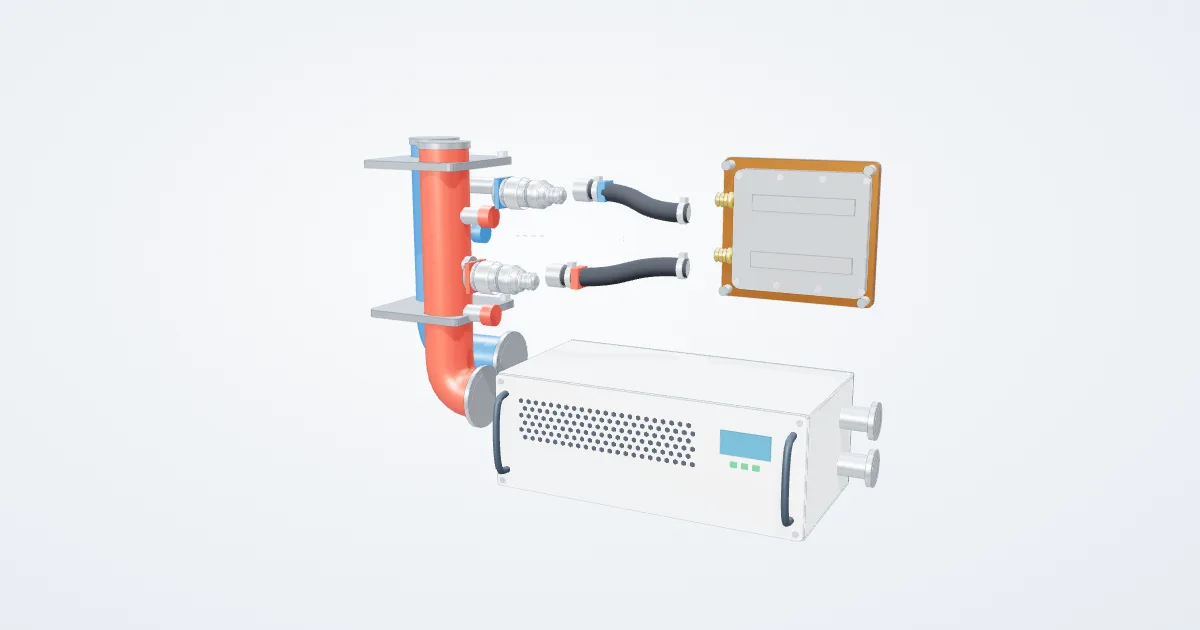
| Part | What it does | Examples of connected listed companies | Private or inside a group |
|---|---|---|---|
| Cold plates | Copper micro-channel plates on GPUs and CPUs carry heat into the coolant | AVC, Auras, Delta, Envicool, SUNON | CoolIT (Ecolab), Boyd Thermal (Eaton), JetCool (Flex), ZutaCore (private) |
| Rack manifolds | Supply and return pipes at the rear feed every tray | Kaori, nVent, Auras, AVC | Motivair (Schneider Electric) |
| Quick disconnects | Dripless couplings let a tray come out without draining the loop | Fositek, Envicool, Amphenol, Dover | Stäubli and Danfoss (private) |
| Coolant distribution unit | Pumps and a heat exchanger separate the rack loop from facility water | Kaori, Delta, Vertiv, nVent, Modine | LiquidStack (private) |
| Fans and rear doors | Cool the parts left on air and capture the exhaust heat | SUNON, Delta, Sanyo Denki, nVent, Vertiv | — |
Why AI racks moved to liquid
NVIDIA’s GB200 NVL72 design calls for 120 kW of cooling per rack. NVIDIA notes that data centers once ran at about 20 kW per rack, while today’s hyperscale facilities can support more than 135 kW, which makes the heat an order of magnitude harder to remove. In Lenovo’s GB300 NVL72 guide about 90% of the rack’s heat goes into liquid; the rest is removed by air.
NVIDIA also says liquid-cooled GB200 NVL72 systems are 25x more energy efficient and 300x more water efficient than traditional air-cooled architectures. Those are NVIDIA’s own comparisons, not measurements of any one site.
Reference: NVIDIA: Blackwell liquid cooling and water efficiency (Apr 22, 2025).
Follow the heat through the loop
Copper cold plates sit on the GPUs and CPUs, and coolant carries their heat through hoses into rear supply and return manifolds. Dripless quick disconnects let a tray slide out without draining the loop; NVIDIA’s design uses a blind-mate manifold with floating tray connections so the couplings align as trays dock.
The coolant distribution unit passes the heat through a liquid-to-liquid heat exchanger to the facility loop and controls pressure, flow and temperature with redundant pumps, filters and leak detection. Lenovo’s guide allows supply water as warm as 45 °C, and NVIDIA says warmer water can reduce or eliminate mechanical chillers in a wide range of climates.
Reference: nVent: coolant distribution units.
In-rack, in-row or sidecar
An in-rack CDU sits at the bottom of one rack: Kaori’s takes the height of four 1U servers, Delta shows a 4RU 140 kW unit for GB300 NVL72, and Supermicro’s GB300 NVL72 rack carries one of up to 250 kW. In-row CDUs serve many racks at megawatt scale, such as Delta’s 2.4 MW and 3 MW units, Lite-On’s 2.1 MW unit and Vertiv’s CoolChip range up to 2,300 kW.
Sites without facility water can use liquid-to-air sidecars, such as Supermicro’s 200 kW unit, which reject the heat to room air. The illustrated rack shows an in-rack unit, but many large deployments use row-level CDUs, so a CDU maker’s exposure depends on which format it sells.
Reference: Delta: power, cooling and microgrid solutions at NVIDIA GTC (Mar 16, 2026).
What stays on air
Liquid covers the hottest parts, not all of them. In Lenovo’s GB300 guide eight dual-rotor fans per compute tray cool the drives, the BlueField-3 DPU, the transceivers and the power distribution board. SUNON puts AI servers at 22.6% of its 1Q26 sales, and Delta, AVC, Sanyo Denki and Nidec also make server fans.
A rear-door heat exchanger can capture the remaining exhaust heat in a water coil before it reaches the room. Ratings in our sources run from 50 kW for Delta’s door and Vertiv’s Liebert DCD to 78 kW for nVent’s RDHX PRO and 120 kW for Supermicro’s door; a rear door is optional in NVL72-class deployments.
Reference: nVent: rear door heat exchangers.
Who makes the parts, and who owns them
Specialists in Taiwan and China document AI liquid-cooling lines: AVC called 2025 its “Inaugural Year of Liquid Cooling,” Auras shows cold plates, manifolds, quick disconnects and CDUs, Kaori markets manifolds compliant with NVIDIA’s NVL72 reference design, Envicool says NVIDIA listed its quick disconnects among MGX ecosystem partners, and Fositek says its quick disconnects entered the GB200 and GB300 supply chain. None names a customer.
Industrial groups have acquired specialists. Eaton completed its Boyd Thermal purchase on March 12, 2026 for $9.55 billion net of cash, Ecolab closed CoolIT on July 2, 2026, and Motivair now sells as Motivair by Schneider Electric and JetCool as a Flex company. Stäubli, Danfoss, Cooler Master and LiquidStack are private.
Reference: Ecolab: closes CoolIT acquisition (July 2, 2026).
What to check before connecting a company
Place the product in the loop, compare ratings in the same unit, and separate a partner list, a reference-design compliance claim and a named program. NVIDIA’s October 2024 OCP post names AVC, Auras, Delta, Envicool, Nidec, nVent, Parker, Sanyo Denki, SUNON and others among 40+ Blackwell infrastructure providers without saying which part each supplies.
Then check scale and governance: servers were 66% of AVC’s Q2 2026 revenue, CoolIT is a small part of Ecolab, and Nidec’s shares were designated a Security on Special Alert after an accounting investigation. Open the cooling parts in the interactive 3D model to see the evidence behind each connection.
Reference: NVIDIA: GB200 NVL72 designs contributed to OCP (Oct 15, 2024).