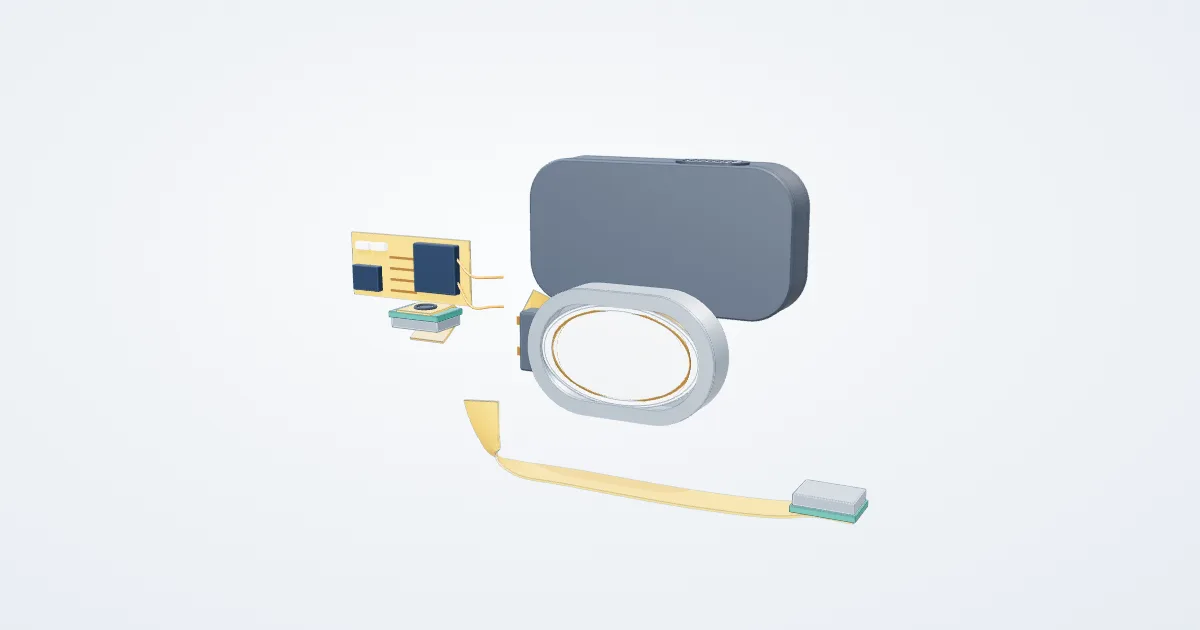
Open-ear speakers sit just in front of the ear and use dual ports to limit sound leakage. An array of four to six microphones plus a bone-conduction pickup isolates the wearer’s voice for AI and calls.
A racetrack micro-speaker in a small ported chamber, MEMS microphones, a bone-conduction voice sensor and the DSP/amplifier path. Venting both sides of the diaphragm adds sound at the ear and partly cancels it farther away, which reduces leakage.
A small driver radiates from both sides of its diaphragm through two ports. The outputs add near the ear and partly cancel farther away; the mic array and a bone-conduction sensor isolate the wearer’s voice.
Illustrative open-ear speaker & mic array. Designs differ by manufacturer; the model is not a bill of materials.
What to look for: The racetrack driver inside its chamber, the two port slots, and the vibration pickup on the head-side face.
It senses the wearer’s own voice through the skull, so wind and nearby talkers barely affect it. In Meta Ray-Ban Display it is teardown-identified as a Syntiant part, and Syntiant is private. Infineon markets vibration sensors for voice pickup in glasses, with no named design win.
Is Knowles still a smart-glasses microphone stock?
Not for this role. Knowles sold its consumer MEMS microphone business to Syntiant, which is private, and the sale closed on Dec 30, 2024. Lists that still name Knowles for glasses microphones are out of date.
The bone-conduction pickup in Meta Ray-Ban Display is teardown-identified as a Syntiant part, and Syntiant is private. Among listed companies, AAC and Goertek disclose acoustic work for AI glasses, and TDK, Infineon and MEMSensing make microphones used in or marketed for glasses.
Open each company below for its source and limitations. Sector membership does not establish a confirmed supply contract.
Inside the assembly
Acoustic chamber & dual ports
The enclosure vents the front and back of the diaphragm through separate ports. Near the ear the two outputs add; farther away they partly cancel, limiting leakage to people nearby.
Stock-link scope: Acoustic-module integration, not standalone mesh or housing supply.
A small moving-coil driver plays sound in front of the ear without sealing the ear canal.
Stock-link scope: AAC and Goertek make micro-speakers and disclose AI/AR-glasses acoustic work; the speaker supplier in any Meta model is not established. Brilliant Labs Halo’s bone-conduction speakers come from Thor Innovation (private).
Also in this part (not publicly listed):Thor Innovation Not publicly listed
MEMS microphone array
Four to six MEMS mics around the frame allow beamforming toward the mouth and wind-noise rejection. Ray-Ban Meta uses five; Meta Ray-Ban Display uses six.
Stock-link scope: MEMS microphones supplied or marketed for glasses: TDK (dual T5838 in Brilliant Labs Halo; ICS-41351 in the sold-out Frame), MEMSensing (says it is the exclusive microphone supplier for Rokid Glasses; Rokid has not confirmed), AAC and Goertek (glasses audio-pickup and MEMS microphone modules), Infineon (IM65D130M announced for Q3 2026) and ST (MP23ABS1 on its Smart Glasses (AR) page). Knowles sold its consumer MEMS microphone business to Syntiant (private) in Dec 2024 and is not mapped.
Also in this part (not publicly listed):Syntiant Not publicly listed
Bone-conduction voice pickup
A vibration sensor against the head senses the wearer’s own speech through bone and tissue, so wind barely affects it. TechInsights found a Syntiant part in Meta Ray-Ban Display.
Stock-link scope: The pickup in Meta Ray-Ban Display is teardown-identified as Syntiant (private). Infineon’s AR and smart glasses page lists vibration sensors for voice pickup, with no named design win. ST’s LSM6DSV16BX is marketed for TWS and XR headsets, not on its glasses page, so ST is not mapped here; MEMSensing’s bone-conduction sensor is still in development.
Also in this part (not publicly listed):Syntiant Not publicly listed
Audio DSP & amplifier
Beamforming, noise suppression and amplification run in the SoC, a Bluetooth audio co-processor or a discrete amplifier; placement varies.
Stock-link scope: Audio SoCs, voice co-processors and amplifiers: Bestechnic and Actions glasses SoCs; Awinic’s AI-glasses amplifiers are in mass production at wearable-AI customers (H1 2026 report); TI’s TPA2011D1 drives the speakers in Brilliant Labs Halo, and TI lists TAA3020/TAD5242 converters on its AR-glasses page; NXP markets i.MX RT audio co-processors. In AR1 designs much of the DSP runs on the Qualcomm SoC, which is listed under Processors.
Disclosed: AAC’s CES 2025 release says its camera, speaker and audio-pickup solutions reached mass production in AR/AI glasses for leading global clients.
Disclosed: Actions’ 2026 interim report says its AI-glasses solutions are in mass production at several unnamed brand customers and lists INMO and Halliday among wearable customers.
Disclosed: Bestechnic’s 2025 annual report says the BES2800 went into mass-produced smart glasses, and its 2026 interim report names RayNeo and Rokid as new glasses customers.
Disclosed: Goertek’s reports describe AI smart-glasses ODM/JDM work with significant 2025 revenue growth, and micro-speakers and MEMS microphone modules for AI glasses; clients unnamed.
Marketed for smart glasses; no named customer. Infineon’s AR and smart glasses page lists XENSIV microphones and vibration sensors for voice pickup, with MCUs, radios and touch sensing.
Disclosed: MEMSensing’s own solution article says it is the exclusive microphone supplier for Rokid Glasses and supplies two microphones in Meizu StarV View; the article is undated (republished Sept 12, 2025).
Partner-disclosed: Rokid’s Jan 2026 releases name the i.MX RT600 as the always-on co-processor beside Qualcomm AR1 in Rokid Ai Glasses Style. NXP also markets radios, PMICs and NFC charging for AI glasses.
Disclosed: Awinic’s H1 2026 report says its AI-glasses audio amplifiers are in mass production at multiple wearable-AI customers and names Meta, Rokid, XREAL, RayNeo, Insta360 and ByteDance among wearables customers.
Marketed for smart glasses; no named customer. ST’s Smart Glasses (AR) page lists IMUs, ToF sensors, STM32 MCUs, Bluetooth LE, charger and converter chips and the MP23ABS1 microphone.
Partner-disclosed: Brilliant Labs’ Halo hardware documents name dual TDK T5838 microphones. TDK also markets SmartMotion IMUs, hinge and wear sensors and eye-intent sensing for glasses.
Partner-disclosed: Brilliant Labs’ Halo hardware documents name the BQ25170 charger and TPA2011D1 amplifier. TI’s AR-glasses solution page lists fuel gauges, audio converters, haptics and Bluetooth LE.
Evidence groupings are not investment ratings. Companies may appear in multiple sectors.
Also in this sector (not publicly listed)
Syntiant Not publicly listed
Its bone-conduction voice pickup is teardown-identified in Meta Ray-Ban Display (TechInsights). It also owns Knowles’ former consumer MEMS microphone business; the sale closed on Dec 30, 2024.