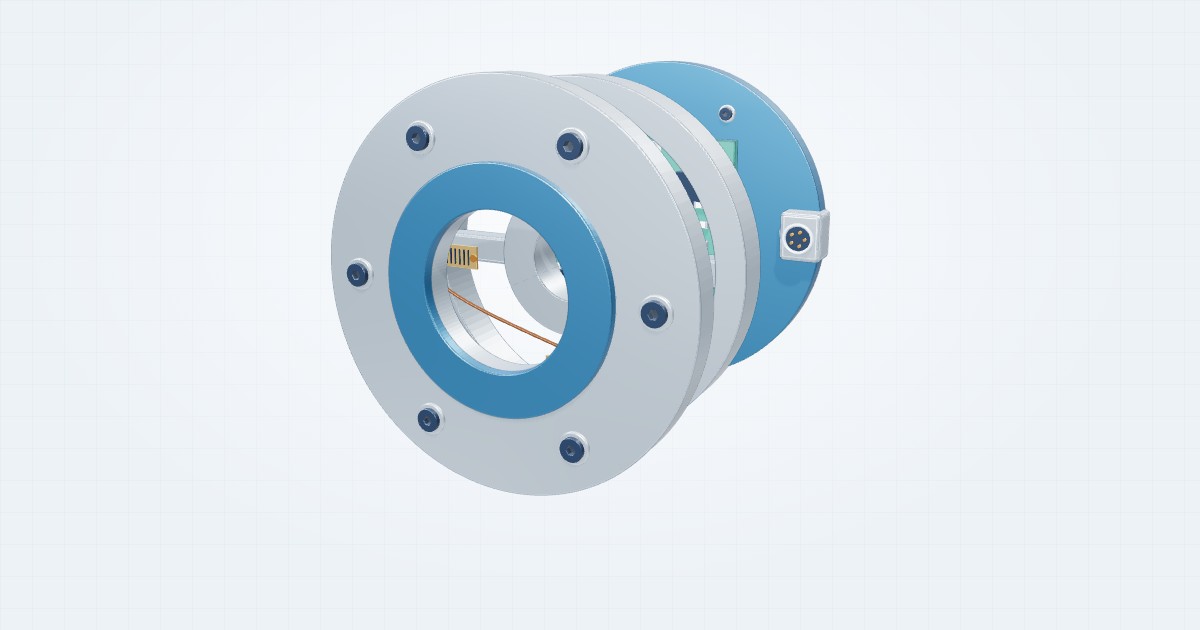
A force/torque transducer measures applied loads. An IMU measures motion; an encoder tracks position. The phrase six-axis can describe different measurements and is not enough to establish a match.
Wrist feedback or fingertip touch?
A wrist force sensor, a miniature force element, and a tactile fingertip sensor are different products. Map the disclosed sensing function to the actual location and role.
Novanta brings ATI force/torque sensing; Renishaw documents encoders in humanoid joints. Analog Devices and ST cover inertial feedback, while TE adds force and position sensing.
Open each company below for its source and limitations. Sector membership does not establish a confirmed supply contract.
Inside the assembly
Tool-side mounting flange
The top interface transfers forces from a hand or foot into the sensing body.
Stock-link scope: Force/torque transducer integrators; the mounting interface belongs to the complete sensor, not a separately verified flange supply business.
Small, controlled deformation under load produces a measurable strain. Geometry separates force and torque components.
Stock-link scope: Complete force/torque sensors use a sensing body. Internal flexure designs vary and are not established by this illustrative geometry.
Bonded gauges convert the flexure’s tiny deformation into resistance changes. The bridges feed precision measurement electronics.
Stock-link scope: VPG’s Micro-Measurements business supplies strain gauges. Miniature packaged force sensors and magnetic position ICs are different technologies.
Amplifiers and analog-to-digital converters turn small electrical signals into calibrated measurements for the control system.
Stock-link scope: Precision measurement and embedded signal-processing electronics. This is not a claim that these companies make a complete six-axis transducer.
The humanoid application portfolio covers power, motor control, and sensing. Hand relevance is control electronics rather than mechanical finger manufacture.
Keli reports its six-axis force sensors at the wrists of Botler humanoids in Zeekr factory testing. Wrist feedback is not the same as fingertip tactile skin.
Humanoid reference designs cover motor drives, BMS, sensing, controllers, and multi-axis hand control. TI supplies chips, not complete mechanical hands.