How this system works
The sensors that turn head motion, taps and muscle signals into commands: an IMU on the board, a touch strip and capture button in the temple skin, a wear sensor, a magnetic hinge sensor, and a dry-electrode sEMG wristband modeled on the Meta Neural Band concept.
Head motion, taps and muscle signals become commands: an IMU senses motion, electrodes sense touch through the frame, and dry electrodes on the wrist read the muscle activity behind finger gestures.
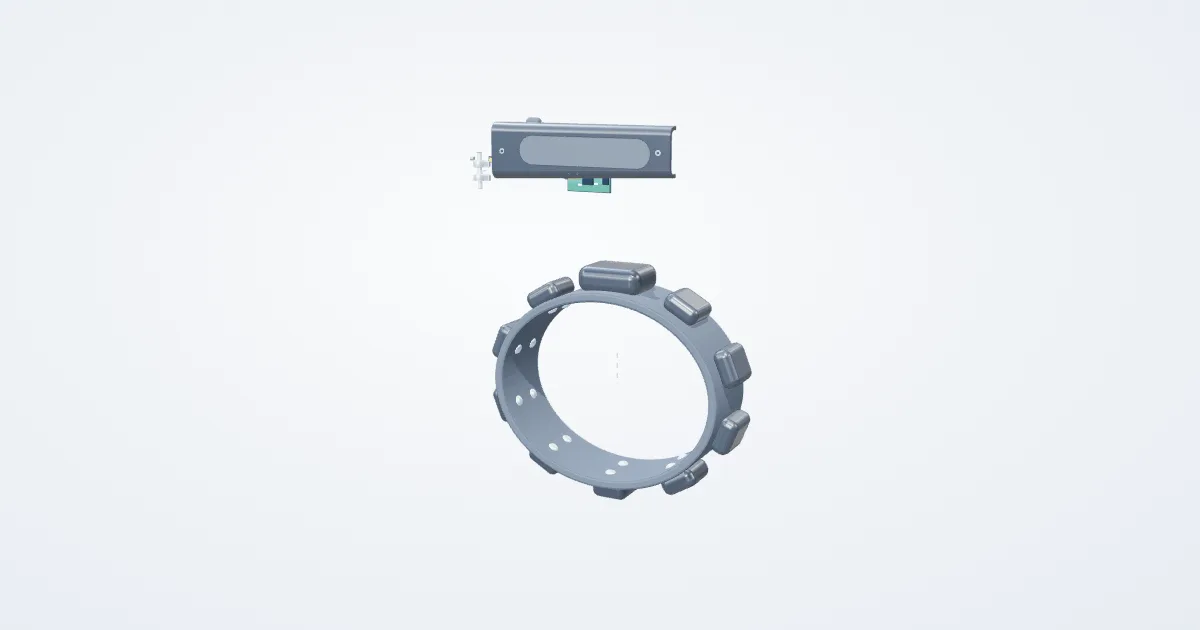
What to look for: The electrode row under the temple skin, the IMU on its board, the magnet-and-sensor pair at the hinge and the electrodes inside the band.
Compare the right roles
What does an IMU do in glasses?
It measures head motion for video stabilization, head gestures and keeping displayed content steady. It is not the wear sensor that detects the glasses on your face, or the hinge sensor that detects them folding. Which IMU a given product uses is not verified in our sources.
Is the Neural Band part of the glasses supply chain?
The Meta Neural Band is a separate wrist accessory sold with Meta Ray-Ban Display. TechInsights found a Qualcomm QCC5100-series chip inside, but no public supplier of its EMG electrodes has been identified.
TDK markets IMUs, hinge sensors and wear detection for smart glasses, ST lists IMUs and ToF sensors on its smart-glasses page, and Awinic lists touch and Hall sensing for AI glasses. Meta’s Neural Band adds wrist EMG input, and TechInsights found a Qualcomm chip inside it.
Open each company below for its source and limitations. Sector membership does not establish a confirmed supply contract.
Inside the assembly
6-axis IMU
An accelerometer and gyroscope track head motion for video stabilization, head gestures and anchoring the display. Which IMU a given product uses was not verified.
Stock-link scope: TDK (SmartMotion for Smart Glasses, custom ICM-45685) and ST (LSM6DSO, LSM6DSOX and LSM6DSV16X on its Smart Glasses (AR) page) market glasses IMUs; which IMU a given product uses is not verified. Bosch Sensortec belongs to private Robert Bosch GmbH.
Also in this part (not publicly listed): Bosch Sensortec Not publicly listed
Touch strip & capture button
Electrodes under the temple skin sense taps and swipes through the frame material; a mechanical button over a dome switch triggers capture.
Stock-link scope: Awinic lists capacitive wear/touch detection (AW93208) on its AI-glasses page; the touch controller in Meta glasses is not identified.
Wear sensor
An IR proximity or capacitive sensor on the inner face detects when the glasses are worn, so they can wake, pause or lock.
Stock-link scope: TDK markets ultrasonic ToF (ICU-30201/ICU-20201) for wear detection in smart glasses; ST lists VL53 ToF sensors on its Smart Glasses (AR) page without stating the use; ams OSRAM’s wear-detection wording is headset-level (its AR/VR page).
Hinge-state sensor
A Hall or TMR sensor and a small magnet detect when the temple folds, so the glasses can sleep.
Stock-link scope: TDK markets TMR sensors for glasses hinges (in use or closed); Awinic lists Hall switches and latches on its AI-glasses page. Magnet suppliers are not mapped.
sEMG wristband
Dry electrodes on the wrist read the muscle signals behind pinches and swipes. TechInsights found a Qualcomm QCC5100-series chip in the Meta Neural Band; its electrode count is not published, so the pods here are illustrative.
Stock-link scope: Meta designs and sells the Neural Band (sEMG); TechInsights identifies a Qualcomm QCC5100-001 SoC and eight sensors inside. Arm says the band is built on Arm CPUs and Ethos-U55 NPUs; the chip carrying the NPU is not identified. No public supplier of the EMG electrodes or analog front-end is identified.