| Layer | Role | What the link does not prove |
|---|---|---|
| Cells | Store electrical energy | A cell maker is not necessarily a pack-enclosure or busbar supplier. |
| Battery management | Monitor, protect, balance and gauge the pack | A BMS chip supplier does not manufacture the battery cells. |
| Power conversion | Deliver suitable voltages to loads | Supplying power chips is different from supplying processors or memory. |
| Pack integration | Connect cells, enclosure, sensing and protection | A complete pack does not establish standalone sales of each internal part. |
Follow the energy through the system
The battery stores energy; the rest of the robot uses it through controlled electrical paths. A pack combines cells, electrical connections, sensing, protection and mechanical support. Its stock-market exposure therefore spans more than battery-cell manufacturers.
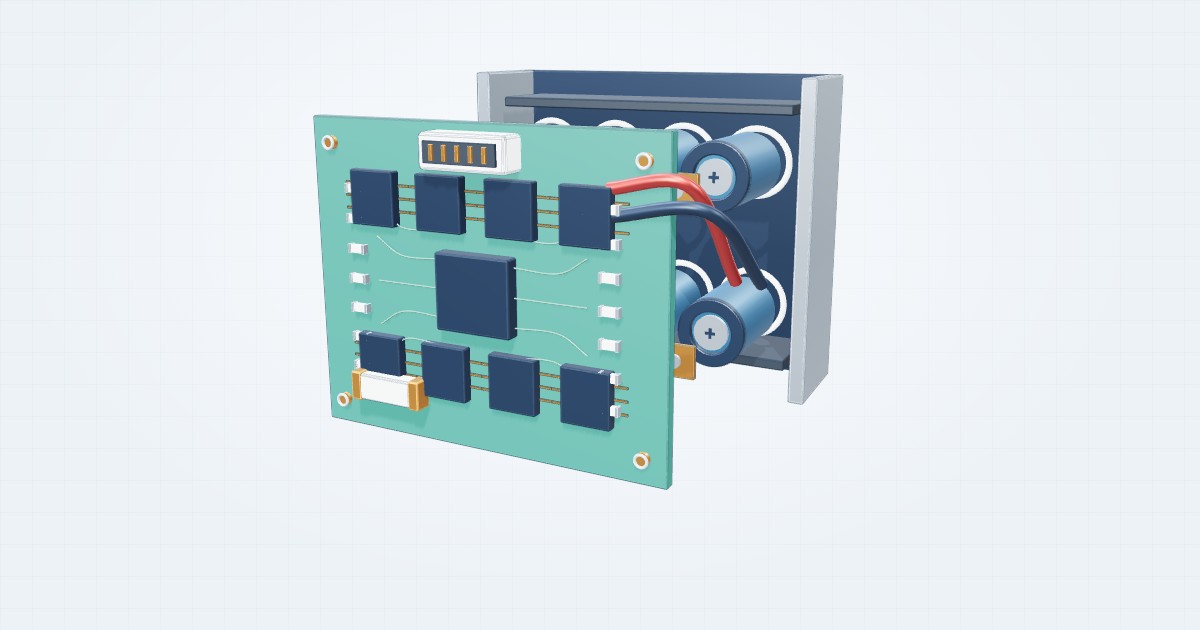
The stock3d battery illustration separates the tray, cells, busbars and battery-management board. Those parts explain the system. They do not identify a commercial pack design, certify its safety, or establish who manufactures every internal component.
Battery management is its own product layer
Texas Instruments describes monitoring, protection, balancing and gauging in its humanoid BMS resources. These functions help explain why a semiconductor supplier belongs in the battery-and-power sector without being a cell producer.
The company’s monitor/balancer portfolio also distinguishes device capabilities and pack configurations. Use the appropriate product evidence when mapping a company to the monitoring board; a broad semiconductor catalog alone does not establish a particular robot contract.
Reference: Texas Instruments: battery monitors and balancers.
Read the commercial stage carefully
A battery supplier can disclose work on humanoids without reporting scaled shipments. Development, sampling, a named deployment and recurring production should remain separate descriptions. An isolated deployment is useful evidence of application, not a market-share estimate.
For each company, read the evidence note and limitation together. If a source concerns service robots or broader robotics, do not silently change the application to a particular humanoid platform.
Compare like with like
Start by separating cell makers, battery-management suppliers, other power semiconductor vendors and system integrators. Then look at each listed company’s wider business mix. Humanoid relevance may be a small part of a large diversified business.
A future financial assessment needs more than a connection to the theme: revenue contribution, costs, margins, funding needs and valuation require their own research. stock3d’s component map helps identify the question and its evidence; it does not replace that assessment.