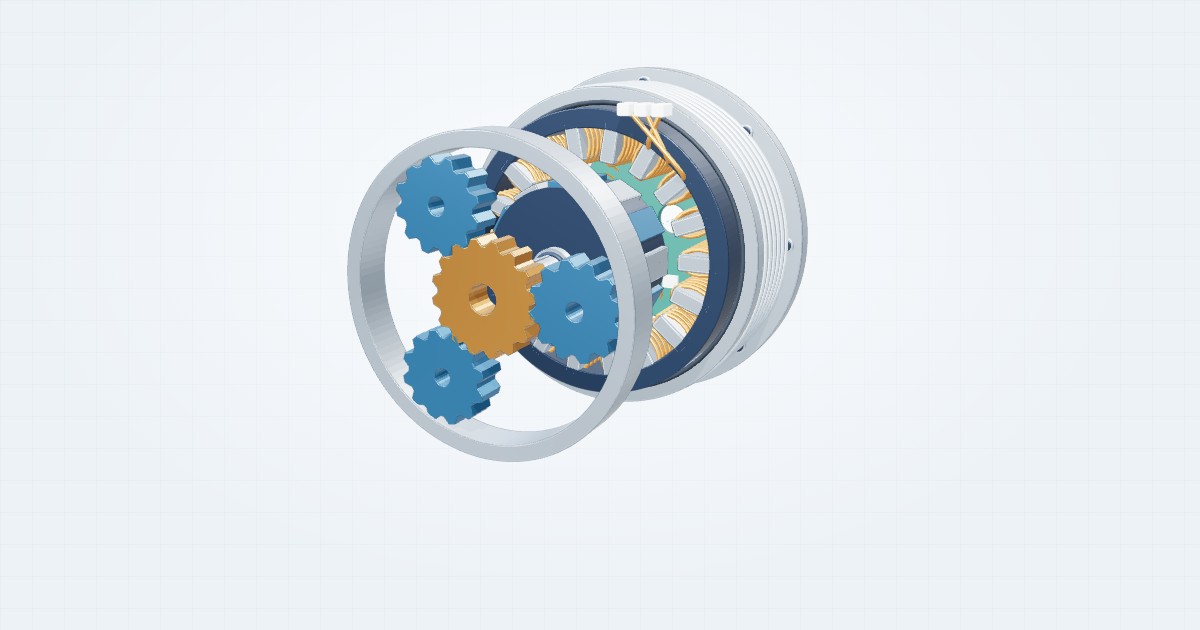
Turn electrical energy into precise motion. Torque density, heat management, and control determine how much a humanoid can lift and how naturally it moves.
A motor generates rotation. An integrated actuator can combine a motor, transmission, sensing, and housing. A drive controls electrical power. Compare companies at the same level of the system.
What establishes humanoid exposure?
Look for a named humanoid application, dedicated product, development program, or partnership. General servo expertise alone does not establish a humanoid production contract.
Harmonic Drive offers focused precision-motion exposure. Kollmorgen, owned by Regal Rexnord, brings frameless motor expertise. Schaeffler has a disclosed humanoid actuator partnership.
Open each company below for its source and limitations. Sector membership does not establish a confirmed supply contract.
Inside the assembly
Housing & mounting flange
A rigid enclosure locates the motor and transfers heat and mechanical loads into the robot link.
Stock-link scope: Integrated actuator developers; a housing is part of the system. These are not verified standalone casting suppliers.
Gearing reduces speed and increases output torque. This illustrative stage is planetary; humanoids also use strain-wave and cycloidal designs.
Stock-link scope: A documented planetary gearbox maker matches this illustration. Strain-wave and cycloidal suppliers appear in the broader Joints & gears sector.
Position feedback and a motor drive close the control loop so the joint follows commanded motion.
Stock-link scope: Includes position encoders, motor-control chips, drive power devices, and integrated controls. Open a company to see its specific role.
The integrated-actuator white paper explicitly discusses humanoid joint requirements; strain-wave expertise does not establish a planetary-gear supply role.
The humanoid application portfolio covers power, motor control, and sensing. Hand relevance is control electronics rather than mechanical finger manufacture.
FMH frameless motors explicitly target humanoid joints. This motor source does not establish production of complete reducers or miniature finger motors.
Leadshine markets humanoid motors, joint modules, and complete dexterous hands. Documented hand designs use geared or screw transmissions, not the model’s tendon.
Tuopu’s March 2026 exchange filing describes humanoid actuation R&D, prototype validation, and small-scale deliveries. It does not identify customers or establish volume leadership.
Sanhua’s 2025 annual report discloses bionic-robot electromechanical actuator R&D, trial production, and sampling. Specific OEM names and scale are not assumed.
Humanoid reference designs cover motor drives, BMS, sensing, controllers, and multi-axis hand control. TI supplies chips, not complete mechanical hands.
Vishay’s September 2026 announcement explicitly describes humanoid motor-control demonstrations. Data-center power exhibits do not prove robot BMS or memory supply.
The April 2026 investor presentation discloses humanoid-actuator development following the Tokyo Robotics acquisition. This remains development evidence.
The listed company documents industrial servo motors and drives. Separate companies using the Estun brand are not automatically consolidated into this exposure.
The official catalogue lists planetary reducers and geared motors. This is a suitable gearbox-architecture match, without an asserted humanoid customer.