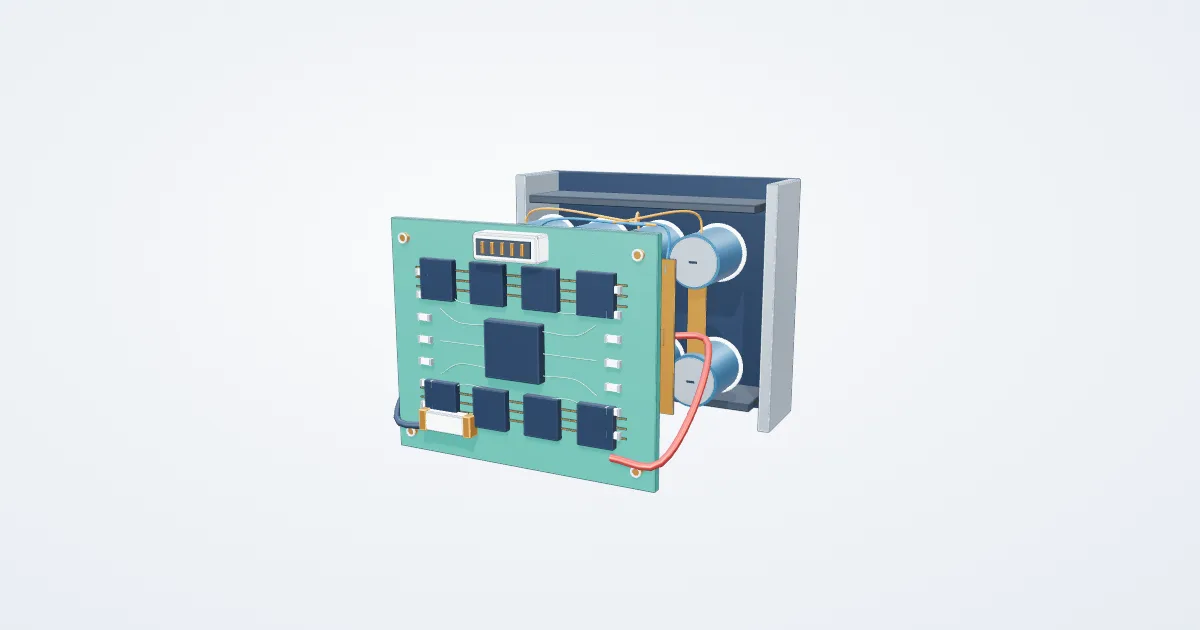
Eight cells illustrate four series-connected pairs of parallel cells (4S2P), with interconnects and a monitoring board. This is not a commercial pack specification.
Four parallel cell pairs connect in series. A BMS monitors the group voltages, pack current and selected temperatures.
Illustrative 4s2p battery pack example. Designs differ by manufacturer; the model is not an OEM bill of materials.
What to look for: Connections on both cell faces and five separate voltage-sense nodes for the four series groups.
Cells store energy. Battery-management electronics monitor and protect a pack; other power chips convert and regulate voltage. These are complementary businesses with different product economics.
Does a robot battery announcement prove scale?
Development, sampling, an individual deployment, and mass production are different stages. The evidence label does not establish significant humanoid revenue or broad battery market share.
LG Energy Solution explicitly markets humanoid batteries. Samsung SDI has a disclosed robot-battery development partnership; TI provides the management electronics.
Open each company below for its source and limitations. Sector membership does not establish a confirmed supply contract.
Inside the assembly
Protective pack enclosure
The enclosure locates the cells and provides mechanical protection. Pack-level capabilities vary by supplier.
Stock-link scope: LG Energy Solution documents complete robot pack integration. The source does not establish a separate enclosure-manufacturing business.
Tabs join each parallel pair, then connect the four groups in series. Series groups add voltage; parallel cells add capacity. Five distinct nodes support group-voltage measurement.
Stock-link scope: Battery power interconnects are Amphenol’s related role; supply of the illustrated welded cell tabs is not established.
A BMS monitors series-group voltages, pack current and selected temperatures. Protection and balancing require suitable circuitry; the illustration omits a complete safety design.
Stock-link scope: Battery-monitoring, protection, balancing, and management electronics. Cell makers and generic motor drivers are listed separately.
The humanoid application portfolio covers power, motor control, and sensing. Hand relevance is control electronics rather than mechanical finger manufacture.
Humanoid reference designs cover motor drives, BMS, sensing, controllers, and multi-axis hand control. TI supplies chips, not complete mechanical hands.