| Sensor | What it measures | Typical research question |
|---|---|---|
| Force/torque transducer | Applied forces and moments | Does the company supply the transducer, its gauges, or signal electronics? |
| Encoder | Position or rotation | Is the disclosed product suitable for joint position feedback? |
| IMU | Inertial motion, such as acceleration and angular rate | Does the source establish inertial sensing rather than contact force? |
| Tactile sensor | Contact information at a surface | Is fingertip sensing explicitly supported by the product disclosure? |
Start with what is being measured
“Robot sensors” is a broad category. A joint needs information about position, the body needs motion feedback, and a hand needs information about contact. A product that answers one question does not automatically answer the others.
Even “six-axis” is ambiguous without context. A force/torque sensor measures forces and moments; an inertial unit combines motion measurements. Matching only the number of axes can create an incorrect supplier link.
Force and torque: measure the load
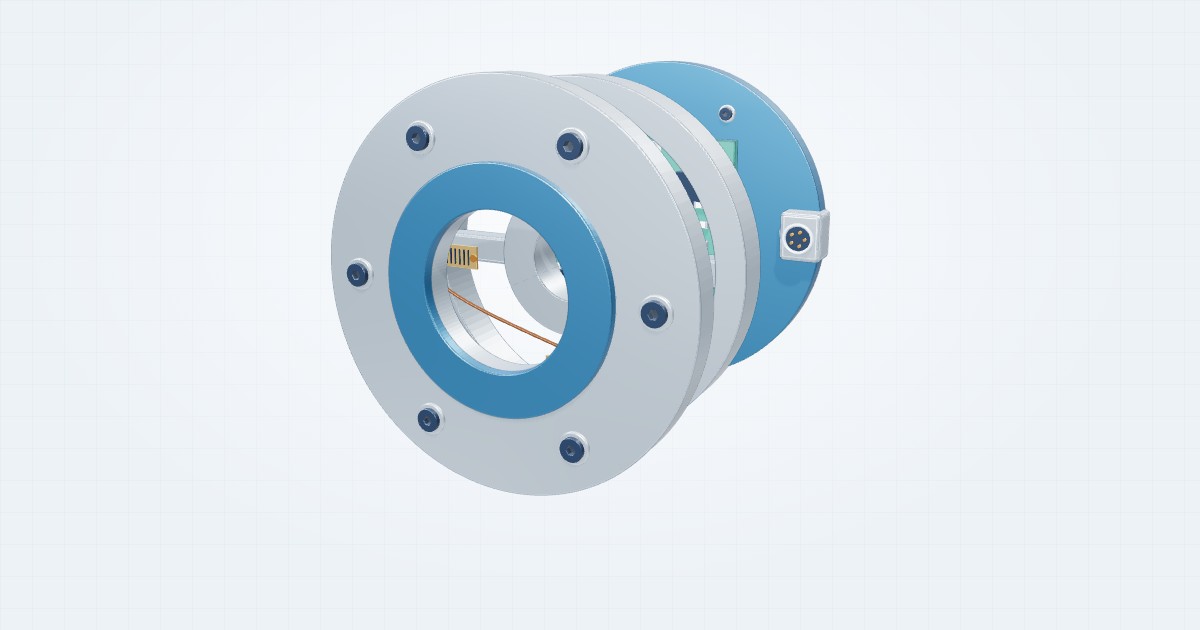
ATI’s catalog describes a sensor system that measures three force and three torque components using an instrumented transducer. In the stock3d illustration, the sensing body, strain gauges and electronics are separated so their roles can be studied.
Distinguish the complete transducer from a strain-gauge element or an analog signal-chain chip. They can participate in the same system while representing different products and different listed businesses. A measurement capability is not proof of a particular humanoid customer.
Reference: ATI: multi-axis force/torque sensor catalog.
Position and motion: different feedback loops
Joint position feedback helps a controller understand the mechanical position. Inertial sensing supports an understanding of motion. Neither should be relabeled as fingertip contact sensing merely because all three feed information into a robot.
Texas Instruments separates position sensing, sensor modules and motor drives in its humanoid design resources. Its system diagrams are useful for understanding electronic roles; individual company claims still need the appropriate disclosure.
Reference: Texas Instruments: humanoid design resources.
Touch: check the location and product
A wrist-mounted force/torque sensor can measure loads transmitted through the hand. A tactile fingertip sensor addresses local contact. A miniature packaged force sensor is another product category. Avoid grouping them as interchangeable “hand sensors.”
Open the exact-part notes in the hand or sensing assembly. They distinguish complete sensor systems, sensing elements and supporting electronics. A company can belong to the broad sensors sector without matching every sensor illustrated in the robot.