How this system works
An elongated pouch cell in a protective steel shell, as iFixit found in Oakley Meta HSTN, with its protection and fuel-gauge board, the PMIC, charging contacts and the charging case’s much larger cell. Published glasses cells range from 154 mAh (2023 Ray-Ban Meta) to about 960 mWh (Meta Ray-Ban Display).
A small lithium-ion cell stores well under 1 Wh. A protection board guards against over-charge and over-discharge while a fuel gauge tracks charge, and the PMIC turns cell voltage into power rails; the case recharges the glasses through contacts.
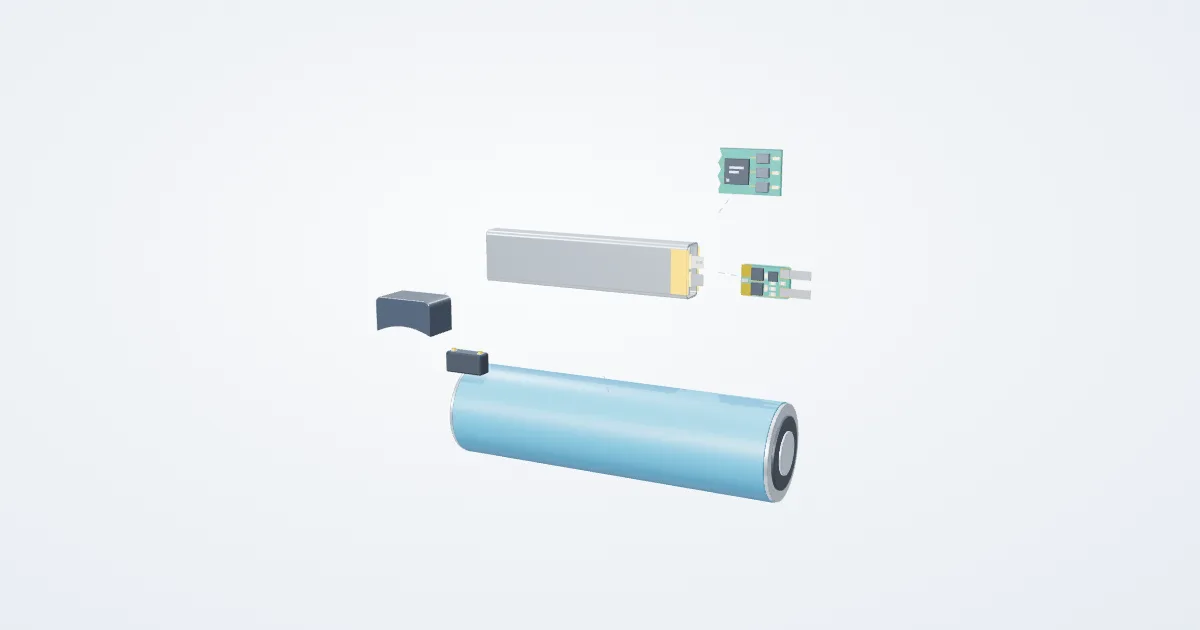
What to look for: The elongated pouch inside its steel shell, the protection board at the tab end, and the much larger case cell.
Compare the right roles
Why are glasses batteries so small?
The whole device must weigh roughly 50–70 g and stay cool against the skin, so the glasses carry around 1 Wh or less in total. The charging case holds many times more energy.
Cells or power chips?
Cells store energy, and power-management chips charge, regulate and protect it. These are different businesses. Enovix discloses cell shipments for an unnamed eyewear platform, while a power chip documented in one open-source device is not a volume design win.
Enovix discloses silicon-anode battery shipments for an unnamed smart-eyewear platform. TI and Analog Devices charger and power chips appear in published glasses hardware documents, and ST, NXP and Awinic market power management for glasses.
Open each company below for its source and limitations. Sector membership does not establish a confirmed supply contract.
Inside the assembly
Li-ion pouch cell
A thin, elongated lithium-ion cell shaped to fit the temple. Silicon-carbon and silicon anodes raise energy density; Enovix began shipping smart-eyewear cells in 2026.
Stock-link scope: Enovix shipped about 2,100 silicon-anode AI-1 packs in Q2 2026 under a 50,000-pack 2026 order for a leading smart-eyewear reference platform (customer unnamed), with about 19,000 ordered for Q3. Cell suppliers for Meta, Xiaomi and others are not identified; Halo’s cells are Grepow (private); ATL (TDK), EVE and Amprius are not mapped without glasses evidence.
Also in this part (not publicly listed): Grepow Not publicly listed
Protection & fuel gauge
MOSFETs, a fuel gauge and a thermistor at the cell tabs prevent over-charge and over-discharge and report state of charge.
Stock-link scope: TI lists BQ27220, BQ27427 and BQ27Z561 fuel gauges on its AR-glasses solution page; the fuel-gauge vendor in any named product is not identified. Awinic’s AI-glasses page lists charger-input OVP, not battery protection, so Awinic is not mapped here.
PMIC & charger
The power-management IC generates the supply rails for the SoC, display and sensors and controls charging. In this archetype it sits on the logic board in the other temple.
Stock-link scope: TI’s BQ25170 charger is documented in Brilliant Labs Halo and Analog Devices’ MAX77654 (with integrated charger) in the sold-out Brilliant Labs Frame; TI, ST, NXP and Awinic (AW32002/AW32005/AW32012 chargers, DC/DC, LDOs) market glasses power management. Meta designed a custom power chip for the Orion prototype.
Charging contacts
Flat or spring contacts, sometimes magnetic, mate with the case or a cable. Their location varies; this archetype puts them under the bridge.
Stock-link scope: GAP: no listed supplier of glasses charging contacts is verified.
No verified direct company match in the current universe.
Charging-case cell
The case carries a much larger cell that recharges the glasses several times: 3,034 mAh in the 2023 Ray-Ban Meta case and an 18650 cell in the Oakley Meta HSTN case.
Stock-link scope: GAP: the charging-case cell and enclosure suppliers are not identified.
No verified direct company match in the current universe.