| Mechanism | How to recognize it | Research distinction |
|---|---|---|
| Planetary | A sun gear, orbiting planet gears, an internal ring and carrier | A complete gearbox product is not proof of standalone gear manufacture. |
| Strain-wave | A wave generator deforms a flexible toothed member | A strain-wave product should not be labeled as a planetary-gear product. |
| Cycloidal | An eccentric input drives a cycloidal reduction mechanism | Industrial reducer applications do not automatically establish humanoid adoption. |
Why a joint uses a reducer
A reducer trades rotational speed for output torque. In a robot, the selected mechanism must fit the joint and work with its motor, bearings, sensing and control. Calling every product a “precision gearbox” hides distinctions that matter when mapping suppliers.
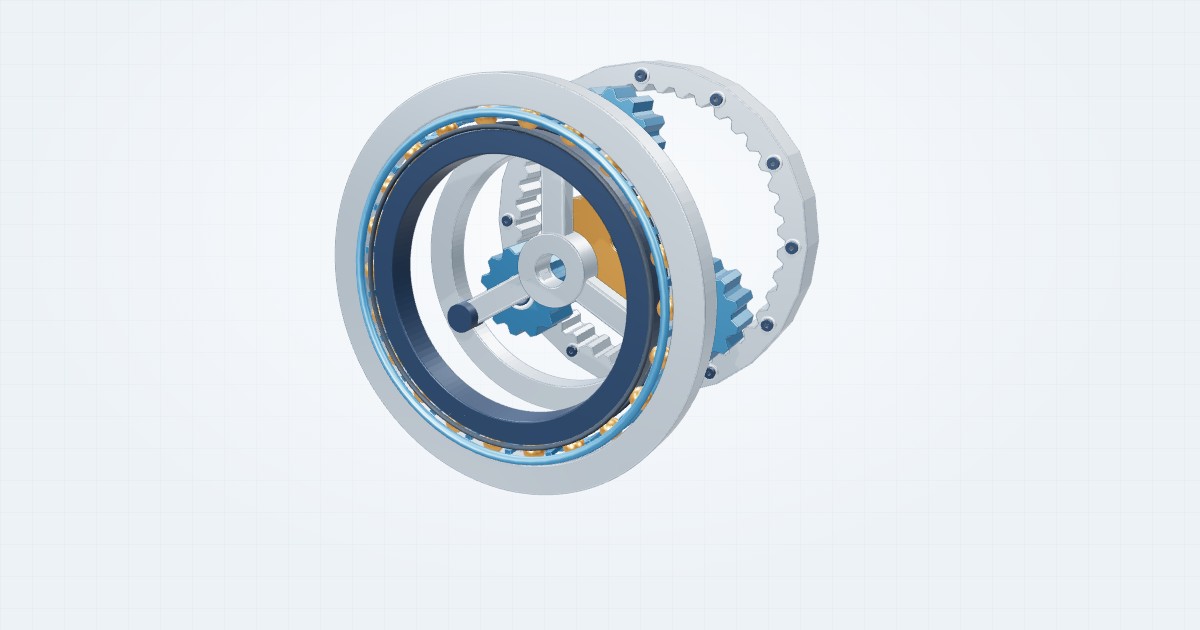
The stock3d joint assembly illustrates a planetary mechanism. Its visible ring, sun, planets and carrier make the torque path easy to study. This is one explanatory design, not a claim that all humanoid joints use planetary gearing.
Strain-wave: a flexible member changes the engagement
A wave generator changes the shape of a flexible toothed member inside a rigid gear. The difference in tooth counts produces the relative movement used for reduction. This mechanism is distinct from a set of planet gears orbiting a central sun.
Harmonic Drive’s technology explanation is a useful reference for the mechanism. Use the company research page separately to assess which listed business and humanoid disclosure the stock3d link represents. A technology explanation does not establish comparative investment merit.
Reference: Harmonic Drive: strain-wave technology.
Keep the application attached to the claim
Nabtesco describes its precision reducers in the context of industrial robots. That reference helps establish its product business; it does not let us assign the same competitive position to every humanoid joint.
When a market-share number is cited, keep the defined product category and application with it. Do not replace “medium-to-large industrial robots” with “humanoids.” The latter would be a different claim requiring its own evidence.
Reference: Nabtesco: precision reduction gears.
Separate the gearbox from its supporting parts
A bearing supplier can support a reducer without making its toothed gears. An actuator developer can integrate a bought-in transmission. A complete gearbox product establishes an integration role but not necessarily sales of every individual gear shown in an exploded model.
Use the exact-part notes in the joint assembly to follow those boundaries. For an investor comparison, start with documented product architecture, customer/application scope and business mix, then investigate commercial scale and financial performance separately.