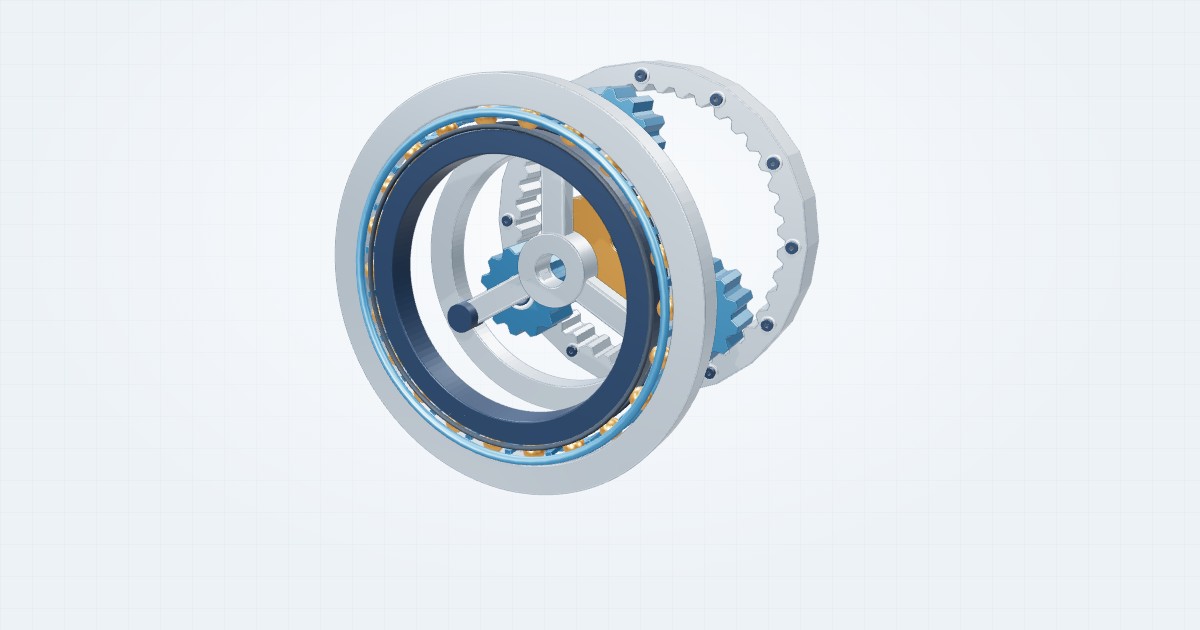
No. Planetary, strain-wave, and cycloidal reducers use different mechanisms. The illustrated planetary gears do not establish that every company in this sector supplies those specific parts.
Does industrial market share imply humanoid leadership?
No. A share estimate for large industrial robot reducers cannot be relabeled as humanoid market share. Keep the application, product category, date, and source attached to the claim.
Compare Nabtesco’s industrial reducer franchise with strain-wave specialists Harmonic Drive and Leaderdrive. Timken spans several gear architectures. Their industrial positions are not humanoid market-share rankings.
Open each company below for its source and limitations. Sector membership does not establish a confirmed supply contract.
Inside the assembly
Internal ring gear
The fixed outer ring has inward-facing teeth. It reacts torque into the joint housing.
Stock-link scope: Zhongda makes complete planetary reducers incorporating ring gears; standalone ring-gear supply is not established.
The integrated-actuator white paper explicitly discusses humanoid joint requirements; strain-wave expertise does not establish a planetary-gear supply role.
Leadshine markets humanoid motors, joint modules, and complete dexterous hands. Documented hand designs use geared or screw transmissions, not the model’s tendon.
The verified product page documents harmonic reducers for six-joint robots. Other motor, hand, and sensor links are withheld pending a specific primary source.
The official catalogue lists planetary reducers and geared motors. This is a suitable gearbox-architecture match, without an asserted humanoid customer.
Evidence groupings are not investment ratings. Companies may appear in multiple sectors.