How this system works
A compact 12 MP module like those in current AI glasses: cover window, multi-element plastic lens with IR-cut filter, CMOS sensor and a flex that runs through the hinge area to the SoC. TechInsights found a Sony sensor in Meta Ray-Ban Display. A premium eye-tracking module is shown alongside.
A multi-element wide-angle lens focuses the scene through an IR-cut filter onto a CMOS pixel array; a flex carries the image data to the SoC’s image signal processor.
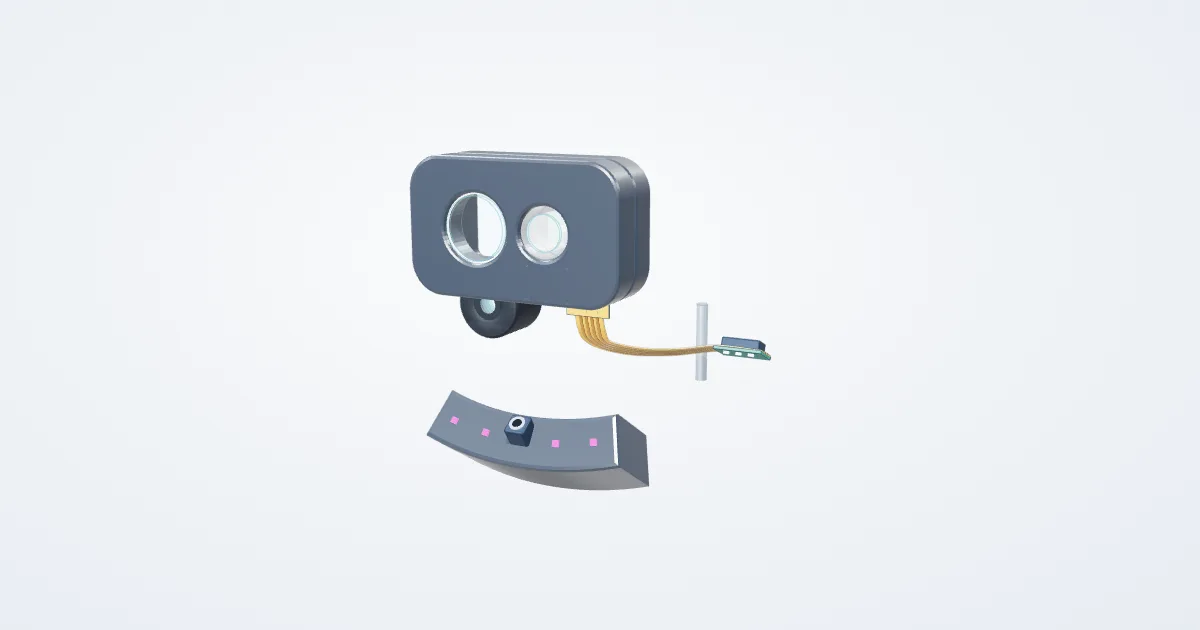
What to look for: The stacked lens elements inside the barrel, the color-filter pattern on the sensor, and the flex that loops toward the hinge.
Compare the right roles
Do all smart glasses have cameras?
No. Some display glasses, such as Even Realities G2, leave the camera out, and camera content varies by model. The illustrated model follows the common layout of one world-facing camera in a corner of the frame.
Sensor maker or module maker?
Sensor companies make the imaging chip; module makers add the lens stack, housing and flex. Sony, OmniVision, GalaxyCore and SmartSens are linked to the sensor, and Sunny and AAC to the module. A module supplier is not automatically the sensor maker, and the reverse is also true.
A Sony sensor is teardown-identified in Meta Ray-Ban Display, and SmartSens and GalaxyCore market 12 MP sensors built for AI glasses. Sunny and AAC report camera modules for glasses. OmniVision, ams OSRAM, Tobii and TDK market eye-tracking parts, a premium feature that camera-and-audio glasses lack.
Open each company below for its source and limitations. Sector membership does not establish a confirmed supply contract.
Inside the assembly
Cover window & capture LED
A sealed, strengthened glass window protects the lens. A nearby LED light pipe lights during capture so bystanders know they are being recorded; this archetype puts the LED in the opposite corner.
Stock-link scope: GAP: no verified supplier for the camera cover window or the privacy-LED light pipe.
No verified direct company match in the current universe.
Lens stack & barrel
A fixed-focus, multi-element wide-angle lens focuses the scene through an IR-cut filter onto the sensor.
Stock-link scope: Camera-module makers with disclosed smart-glasses imaging work: Sunny (smart-glasses imaging modules, 2025 annual results) and AAC (camera solutions in mass production for unnamed glasses clients, CES 2025). Lens-element makers (Largan, Genius) were excluded for lack of glasses evidence.
12 MP CMOS image sensor
A back-illuminated pixel array under a color filter converts light into data; the SoC’s image signal processor handles HDR, stabilization and compression.
Stock-link scope: Sony’s sensor is teardown-identified in Meta Ray-Ban Display (TechInsights, June 2026); Sony has not confirmed. IMX681 in Xiaomi and Quark glasses is press/spec-sheet only. OmniVision’s 720p OV09734 was in Brilliant Labs Frame (sold out). GalaxyCore reports 5, 8 and 13 MP CIS in mass production in AI-glasses projects (H1 2026 report) and launched the 12 MP GC12C1. SmartSens markets 12 MP AI-glasses sensors (SC1200IOT, SC1220IOT) with no named customer.
Camera flex & connector
A MIPI CSI flex carries image data to the logic board, looping through the hinge area. iFixit notes delicate camera ribbons in the Oakley Meta HSTN hinge.
Stock-link scope: Camera-module makers integrate the flex and connector; standalone flexible-circuit and connector suppliers are not identified.
Eye-tracking camera & IR LEDs
Premium AR designs such as Meta Orion add small inward-facing IR cameras and near-infrared LEDs for gaze input. Ray-Ban Meta-class glasses do not have them. Infrared is invisible, so the model shows it in magenta.
Stock-link scope: Eye-tracking sensors, IR illuminators and platforms marketed for smart glasses (OmniVision OG0TC, ams OSRAM FIREFLY IR LEDs, Tobii’s glasses platform, TDK AIsight), with no named mass-market design win. Ray-Ban Meta-class glasses have no eye tracking. Himax’s WiseEye glasses customer and its function are undisclosed, so Himax stays at sector level.